10 Myths About Spain That Didn't Survive Two Years of Real Life

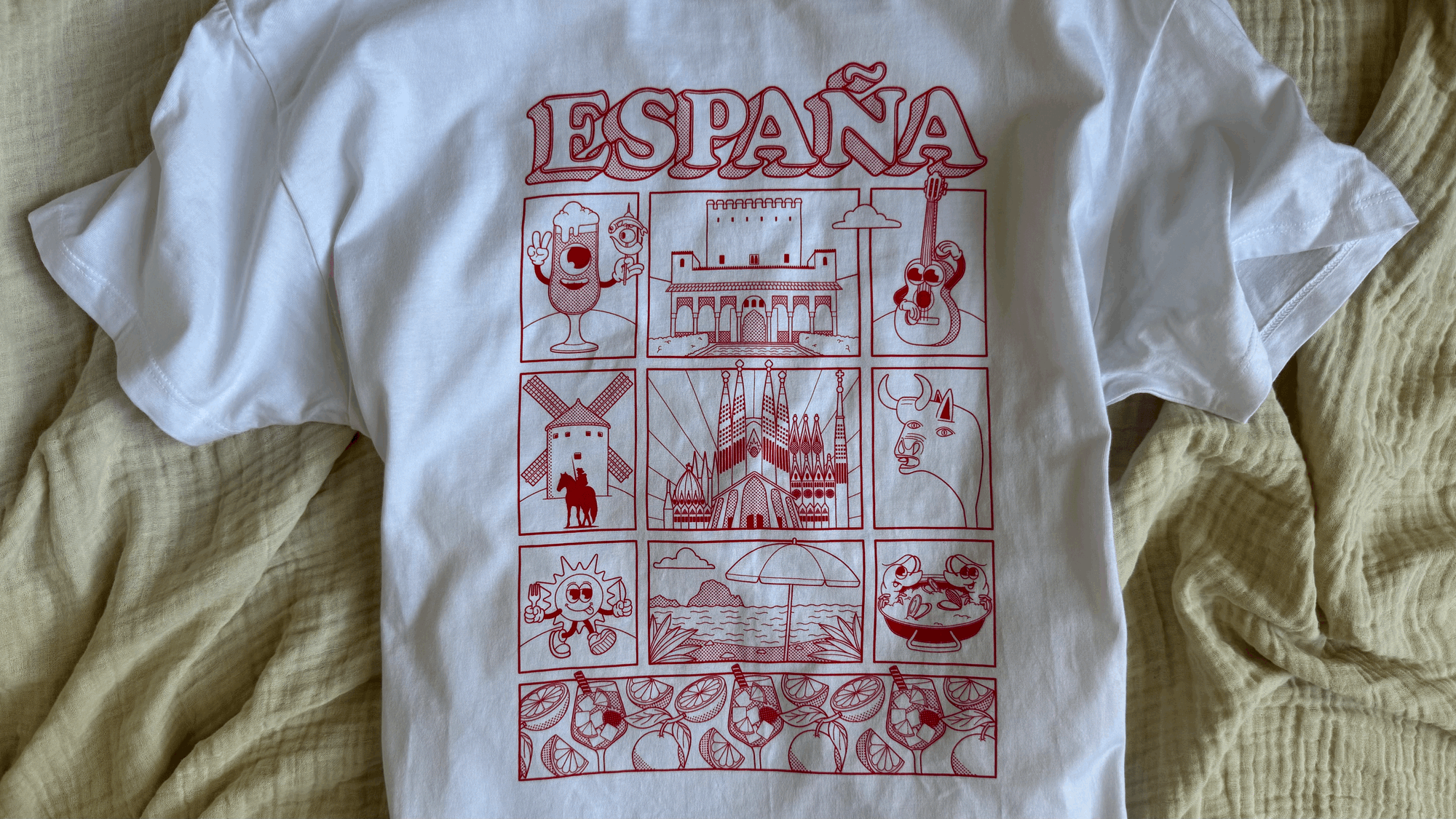
I bought this T-shirt for my mum and only later realised that it was basically a complete Spain starter pack.
Sun. Sangria. Flamenco. Bulls. Paella. Windmills. The Sagrada Família.
None of it is wrong.
It is simply not the whole story.
After two years of living between Poland and Spain, I have realised that many of the ‘facts’ I heard before coming here were not exactly lies. They were simply incomplete.
Spain is not the country from Instagram reels or souvenir T-shirts. It is much more ordinary, much more nuanced and, somehow, much more interesting.
These are the stereotypes that quietly disappeared once everyday life took over.
1. Everyone Shops at Mercadona
I can probably count my visits to Mercadona on one hand.
My local supermarket has almost always been Consum. Depending on where you live, it could just as easily be Lidl, Bonpreu, Carrefour or Dia.
Mercadona is popular.
It simply is not the centre of the Spanish universe.
2. Spaniards Are Always Late
People are people.
Some arrive early. Some are perfectly punctual. Some are always running ten minutes behind.
When I met my new academic host at the university, she was there on time. The meeting simply lasted longer than expected because we had a lot to discuss. That was not ‘Spanish time’. It was a good professional meeting.
The stereotype also collapses under the weight of ordinary life. Universities open, hospitals operate, shops function, trains leave and people go to work. A country could not run on permanent lateness.
Countries do not have one collective personality.
People do.
3. Spanish Is an Easy Language
Hold my beer.
Yes, the pronunciation is relatively straightforward. Many words seem familiar, and it is possible to start communicating quite quickly.
Then the verbs arrive.
Then the subjunctive.
Then the pronouns, prepositions, irregular forms and all those tiny grammatical constructions that somehow know exactly where your confidence lives.
After two years, I think I can communicate and make myself understood.
I can also make ten mistakes in a single sentence with remarkable efficiency.
Spanish is not impossible.
It is simply not the effortless language people often claim it is.
4. Once You Learn Spanish, You Will Understand Spaniards
That is an entirely different challenge.
Language apps speak slowly. Teachers speak clearly. Textbooks are unfailingly polite.
Then two Spaniards start talking to each other.
At full speed.
Words merge. Syllables disappear. Whole sentences seem to become one continuous sound, delivered somewhere between ordinary speech and machine-gun fire.
Suddenly, you begin questioning every hour you have ever spent studying.
Learning Spanish is one thing.
Understanding Spaniards talking to each other is an entirely different sport.
5. All Spaniards Look the Same
Dark hair.
Dark eyes.
A perfect Mediterranean tan.
Reality is far more interesting.
Spain has blondes, redheads, people with blue or green eyes, very pale skin and every possible combination in between.
Regional differences matter. Family histories matter. Centuries of movement and migration matter.
The idea that there is one recognisable ‘Spanish look’ belongs more to cinema, advertising and holiday brochures than to everyday life.
Countries do not have one face.
6. Dinner at 10 p.m. Is Impossible
When I first came to Spain, my Central European stomach strongly disagreed with the local timetable.
Ten o’clock felt absurdly late for a proper meal, and it occasionally caused some friction between Javi’s rhythm and mine.
Two years later, something has changed.
My internal clock has quietly moved south.
Eating late no longer feels quite so strange. My metabolism may even have accepted that this is simply how life works here.
I also assumed that living in Spain would inevitably make me gain weight. Long meals, late dinners, tapas — surely the consequences were obvious.
That was not my experience.
Barcelona keeps you moving. You walk everywhere. You take the metro. You climb hills without thinking about it. You go to the gym, run, spend more time outdoors and cover surprising distances during an entirely ordinary day.
The rhythm of eating changes.
So does the rhythm of living.
7. Siesta Is Just a Tourist Stereotype
Not quite.
Barcelona is a major city, so shopping centres, supermarkets and public transport continue to operate throughout the afternoon.
But many smaller shops, local services and neighbourhood restaurants still close at around two and reopen later, sometimes at five.
And honestly?
I consider the siesta one of humanity’s finest inventions.
When it is 35°C outside, slowing down for a while stops looking like laziness and starts looking like common sense.
Somewhere along the way, I adopted the habit myself.
I have even practised it in France.
8. Living Abroad Feels Like Being on Holiday
Perhaps during the first week.
Then real life quietly returns.
There are deadlines to meet, emails to answer, groceries to buy, washing to do, banks to deal with, appointments to arrange and paperwork to complete.
Some of my work is remote, but ‘remote’ does not mean ‘optional’. It still has to be done, whether I am sitting in Poland or Barcelona.
And no, living in Spain does not mean eating poetic little plates of tapas every evening.
At some point, you still have to decide what to put in the pot.
People in Poland sometimes imagine that my life here must be permanently sunlit and effortlessly glamorous. The sky may be different. The climate may be kinder.
The work, however, does not do itself.
The difference is not that everyday life disappears.
The difference is that everyday life happens under a different sky.
9. One Day You Will Stop Feeling Like a Foreigner
You probably will.
Just not because you suddenly become local.
It happens when you stop thinking about it all the time.
I have accepted that my Spanish is not perfect. Sometimes I make ten mistakes in one sentence. Sometimes I switch to English because it is easier, faster or simply more practical.
None of this prevents me from living my life.
I no longer treat every linguistic mistake as evidence that I do not belong. I am an expat. I come from somewhere else. That is not a temporary flaw waiting to be corrected.
Belonging does not always mean blending in completely.
Sometimes it simply means becoming comfortable with the difference.
10. Home Does Not Always Look the Way You Expect
Sometimes Poland appears in Barcelona in unexpected forms.
Sometimes it is the Polish tourists you can hear almost everywhere in the city centre.
Sometimes it is something much less obvious: an InPost parcel locker, a Punto Pack collection point or a familiar yellow logo appearing in the middle of an ordinary Spanish street.
There is something oddly comforting about recognising a Polish logistics brand abroad.
You may be living in another country, speaking another language and following a different rhythm, and then suddenly there it is: a small reminder that the distance between your two homes is not quite as large as it sometimes seems.
Home has a funny way of travelling with you.
After two years, I have realised that living abroad is not about replacing one home with another.
It is about slowly discovering that your life has learnt to exist in both.
Two years ago, Spain looked rather like the T-shirt I bought for my mum.
Today, it looks much less like a souvenir.
And much more like home.