The Price of Staying

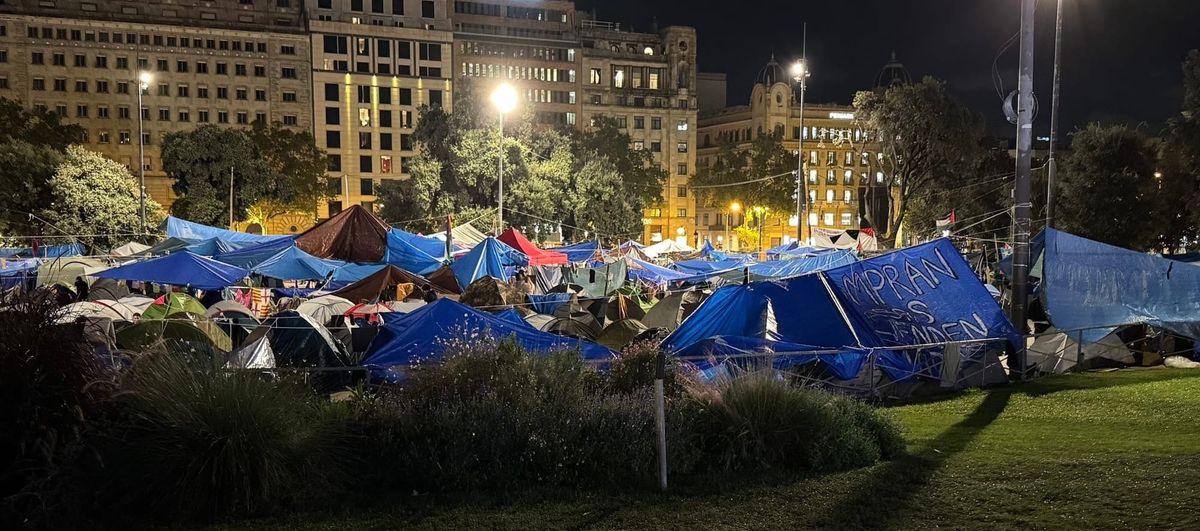
On a night in Plaça de Catalunya, Barcelona's housing crisis becomes impossible to overlook.
Plaça de Catalunya is one of those places in Barcelona where something is always happening. People rushing to catch the metro, tourists navigating their way towards La Rambla, shoppers carrying bags from the surrounding department stores. It is a place of movement, commerce and the everyday routines of a large city.
But on a recent evening, the square looked rather different. Hundreds of tents had appeared between its fountains, monuments and carefully maintained greenery. Blue tarpaulins stretched across the grass, temporary shelters stood beneath the streetlights, and handwritten messages explained why people had decided to make one of Barcelona's most recognisable public spaces their temporary home.
The encampment began on 29 September, following a wave of protests that had started in Madrid. Just days earlier, 87-year-old Maricarmen Abascal had been evicted from the rented flat where she had lived for more than 70 years. Her case prompted thousands of people to take to the streets, and on 26 September, protesters began camping in Madrid's Puerta del Sol. Within days, similar demonstrations had spread to other Spanish cities, including Barcelona.
Maricarmen never returned home. Although an agreement was eventually reached that would have allowed her to move back into her flat, she died in hospital on 7 October, before it could take effect. By then, her story had become a symbol of Spain's housing crisis, and the protests had grown into a broader movement demanding protection against evictions and better access to affordable housing. EFE
The location was hardly accidental. Plaça de Catalunya is not simply a convenient meeting point. It is also one of the most commercially valuable addresses in Barcelona.
And that was something Javi pointed out while we were looking at the encampment.
Look around Plaça de Catalunya and you will find some of the world's most recognisable retail brands. Apple occupies a magnificent former banking building on the corner of Passeig de Gràcia. Primark has an enormous flagship store close to La Rambla. El Corte Inglés dominates another side of the square, while hotels, offices and other commercial properties complete the picture.
These are not exactly modest addresses.
The contrast between the tents and the surrounding architecture is striking, but the story becomes more interesting when you begin asking who actually owns the buildings.
Apple, for instance, is an American company, but its Barcelona flagship occupies a property acquired by Pontegadea, the investment company associated with Spanish billionaire Amancio Ortega.
Primark, meanwhile, rents its premises in a building that has changed hands through major property transactions. According to the real estate investment company IBA Capital, the property was incorporated into an investment vehicle involving institutional and private investors in 2019. The company describes it as a prime commercial asset designed to generate long-term returns.
El Corte Inglés, by contrast, is a Spanish retail group with its own complicated property history.
So the distinction is not quite as simple as foreign corporations versus local residents. Behind the familiar shopfronts lies a more intricate geography of ownership, investment funds, property companies and concentrated wealth.
In fact, an earlier investigation by 3Cat documented how Plaça de Catalunya had gradually transformed from a centre of banking into a showcase for international retail brands and major property investors.
The commercial buildings surrounding the square are not residential properties, of course, and their rental markets operate differently. Yet their history reveals something about the economic value attached to this particular piece of the city.
Meanwhile, just a few metres away, people are sleeping in tents to demand better access to housing.
One message, sprayed in purple paint onto the stonework beside the fountain, caught my attention:
La nostra casa no és el vostre negoci.
Our home is not your business.
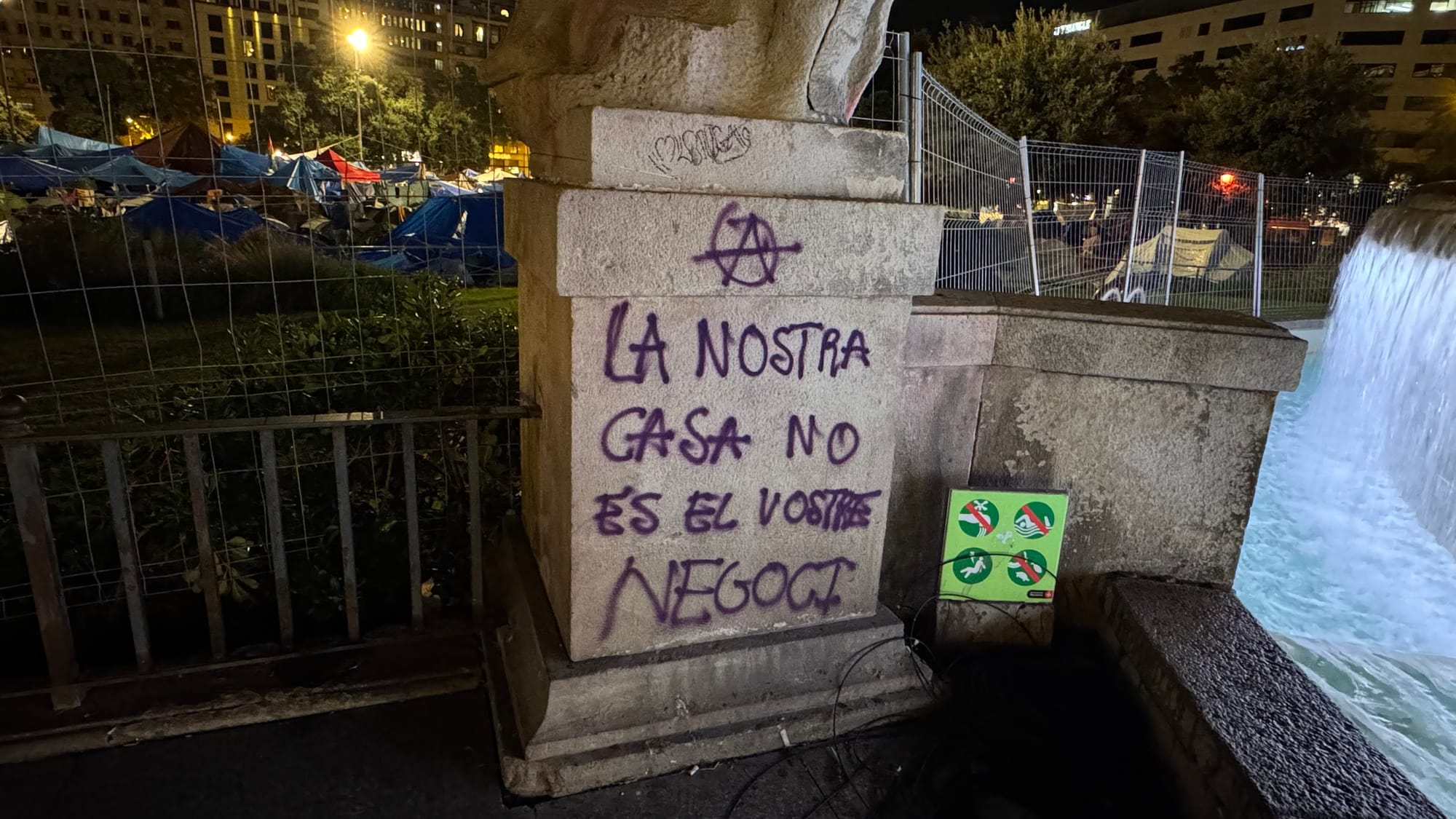
There is something particularly powerful about that sentence in this particular setting. The Catalan word negoci makes the commercial meaning unmistakable. A home is not supposed to be merely another opportunity to generate profit.
Barcelona has been grappling with housing affordability for years. Rising property values, pressure from tourism, investment activity and limited housing availability have all contributed to a market that many residents struggle to navigate.
According to official Catalan government statistics, the average monthly rent recorded in new residential rental contracts in Barcelona reached €1,137.35 in the first quarter of 2026. The figures vary considerably between neighbourhoods, and recent rent regulation has moderated some prices. Nevertheless, affordability remains a serious concern.
The question is no longer simply how much it costs to live in Barcelona, but who can reasonably afford to remain here.
And remaining matters. A city is not made exclusively of its architecture, restaurants, museums or commercial attractions. It also depends on the people who maintain everyday life: those who work in hospitals, schools, shops and offices, raise families, maintain friendships and participate in their neighbourhoods.
When housing becomes increasingly inaccessible, the consequences extend beyond individual household budgets. They affect the social composition of the city itself.
What struck me most about the encampment was how easily two different versions of Barcelona existed side by side.
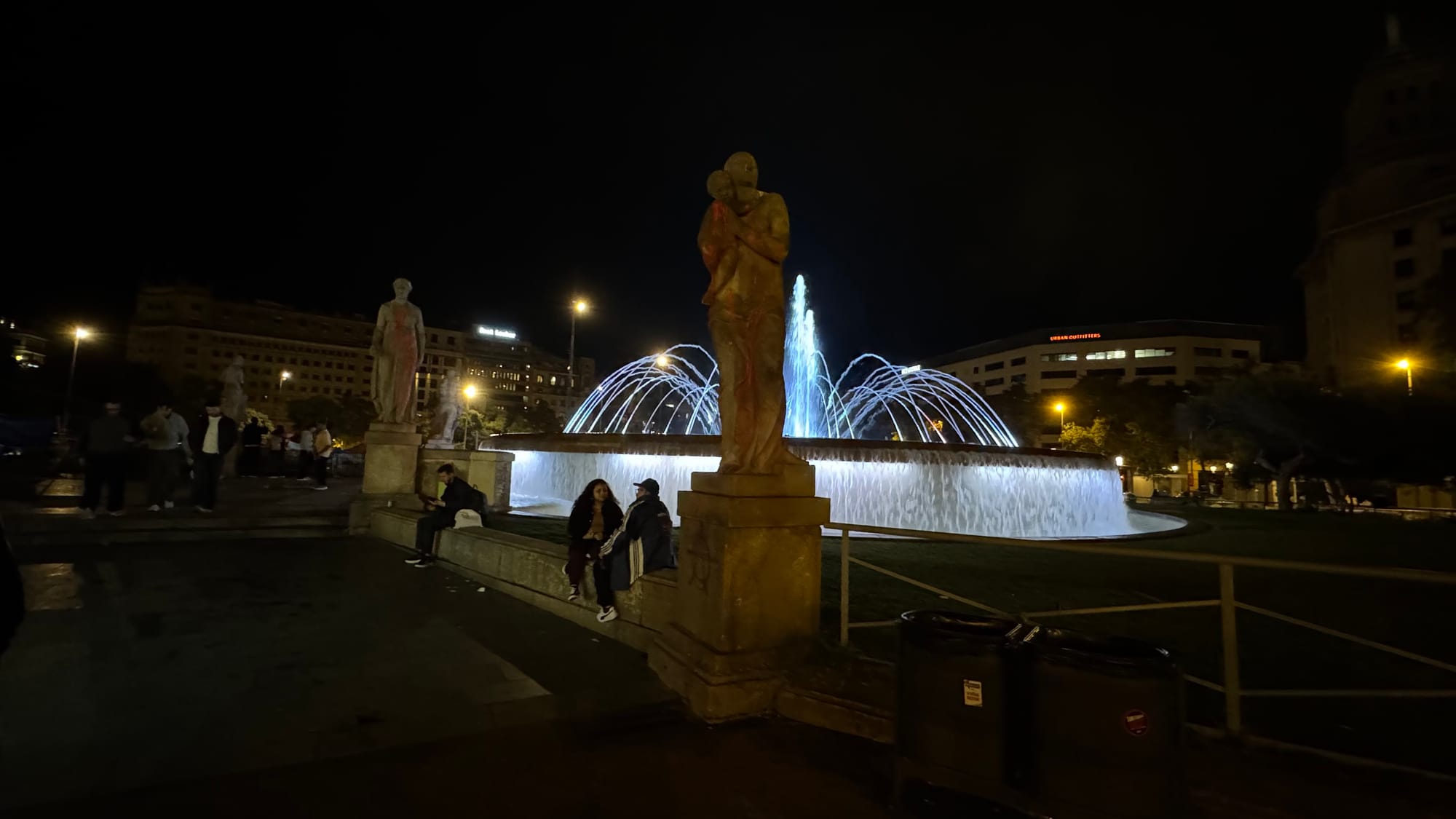
The illuminated fountain continued operating, although some of the statues surrounding it had been sprayed with paint. People sat nearby, talked, took photographs and went about their evening. The city had not stopped functioning, but the contrast was difficult to ignore: an iconic public square, a sprawling protest encampment and visible damage to the monuments that form part of its architectural heritage.
There is an interesting historical echo here, too. In 2011, Plaça de Catalunya became one of the central gathering places of the 15-M movement, when protesters occupied public squares to challenge political and economic inequalities. Fifteen years later, tents have returned, this time with housing at the centre of the demands.
Of course, Barcelona's housing crisis cannot be explained by a single factor, nor can it be solved by identifying a handful of wealthy property owners. The relationship between urban development, investment, tourism, regulation and the availability of homes is considerably more complicated.
But sometimes a public square can reveal a contradiction more clearly than a report filled with statistics.
Walking around Plaça de Catalunya that evening, I kept returning to the message written beside the fountain. It seemed an unusually direct response to a question that has become central to contemporary urban life: what happens when the financial value of a place begins to compete with its value as somewhere to live?
Barcelona is a city with enormous international appeal. For the people who call it home, however, its worth cannot be measured solely in property transactions, commercial rents or visitor numbers.
And perhaps that is what the tents in Plaça de Catalunya are asking us to consider: not simply how much the city is worth, but who gets to stay in it.


