Between Two Homes, by Airbus

I prefer the aisle seat.
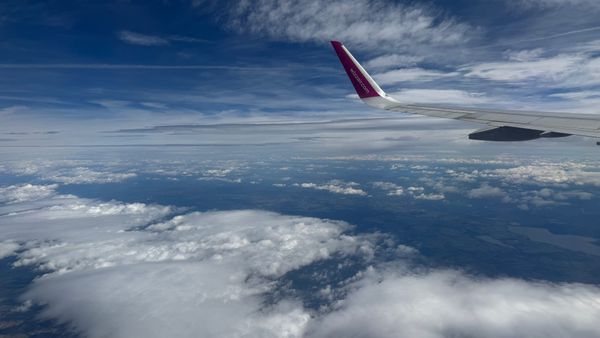
I still like looking through an airplane window. Who doesn’t? But somewhere along the way, flying between Barcelona and Poland stopped feeling like travel to me.
It became transit.
I sometimes joke that Airbus is an exceptionally literal name. An air bus. Some people commute by train. Some drive for two hours. Some take a coach or a FlixBus between cities. I occasionally commute by jet.
It sounds much more spectacular than it feels.
A flight between Barcelona and Poland takes roughly two and a half hours. Driving from Barcelona to Madrid takes longer. Getting from Katowice to Warsaw can take a comparable amount of time before traffic has even had its say.
My commute simply involves a runway.
There is no need to turn this into a story about globalisation, the shrinking world or how wonderfully mobile we have all become. Human biographies simply produce different maps.
This happens to be mine.
And after repeating the same route often enough, I have become very good at removing uncertainty from it.
I know airports. Not in the glamorous frequent-flyer sense. I simply use them a lot.
I know the tricks for finding out where a gate is likely to be before everyone starts staring at the departure screens. Yes, some of them came from TikTok. I know the security procedures so well that most of the time I barely think about them. I know the safety demonstrations almost by heart. I know where the life jacket is likely to be stored. I know how an overwing emergency exit works.
I know what I like to wear.
Usually trousers that cover my legs, even in summer. Not because I am dressing for an expedition but because airplane cabins can be cold and I do not particularly enjoy pressing bare skin against a seat that has accommodated several hundred strangers before me.
I know how I like to pack.
Most of the time I travel very lightly. Sometimes it is just a backpack. Sometimes I add a cabin-size trolley. Checking a suitcase is unusual for me and normally means that I am moving a larger quantity of things between my two homes.
I like my CabinZero Tech backpack for an extremely unromantic reason: everything has its place. Technology can be separated from everything else. Laptop here. Chargers there. Documents where I expect them to be.
This is not a sponsored declaration of love to a backpack.
It is about predictability.
I reduce uncertainty to almost zero.
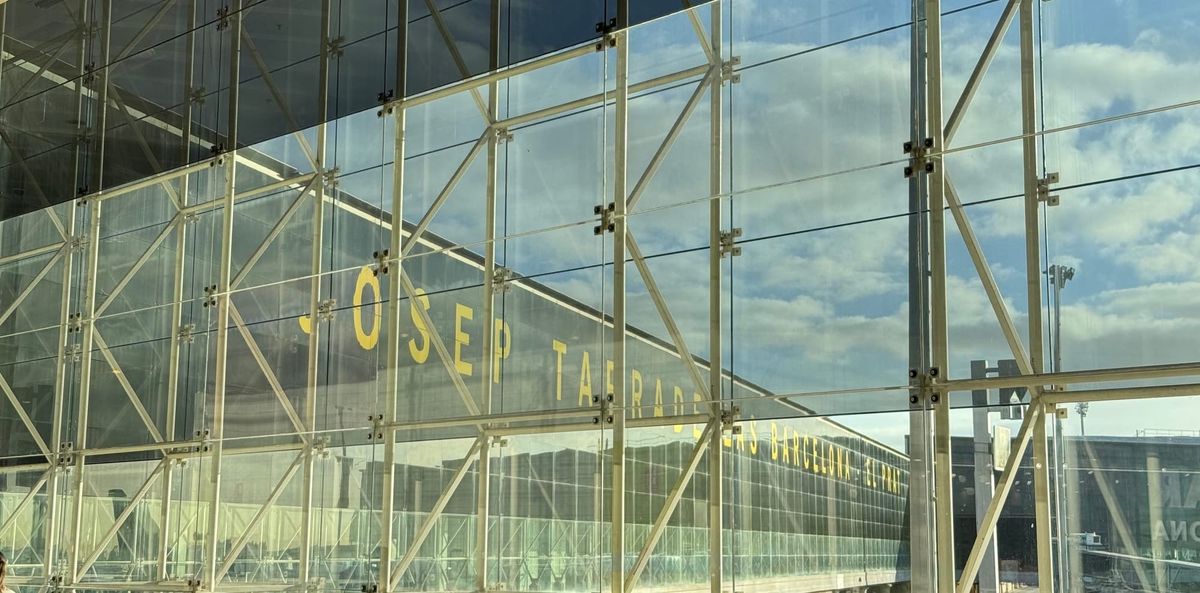
At El Prat, most of the sequence now happens automatically.
Security. CT scanners. Nothing to take out. Duty free, perhaps, if I feel like wandering around or looking at something while I wait. Then I find somewhere to sit.
And I eat my sandwich.
Usually one I made at home.
It is a small thing, but I have realised that it matters to me.
I do not bring food because I believe airport food is morally inferior, nor because I am trying to perform some heroic version of healthy travel. I have eaten poke bowls and salads at airports. If I have no time to prepare anything, I buy something I know I will like.
But if I can choose, I prefer food that came from home.
I know what it tastes like. I know what is in it. I made it in my own kitchen, wrapped it there and carried it with me through security.
For a few minutes, in a terminal designed almost entirely around circulation, I eat something that belongs to the place I have just left.
I do the same in Poland.
The ritual works in both directions.
There is also a practical side to it. Pilots are famously careful about what they eat before flying, for very obvious reasons. My version is considerably less dramatic, but the logic is similar: this is not the moment when I want to discover that my stomach has developed an opinion about an experimental lunch.
So I eat before boarding. In the aircraft itself I generally do not.
I chew gum. Too much gum, probably. Sometimes I have sugar-free sweets. Occasionally a protein bar, particularly when stress makes me want something sweet and I decide that surviving entirely on sunlight and virtue is not necessary.
Water, yes.
Food, usually no.
Then there is the waiting.
The gate appears.
Boarding begins.
Seat.
Aisle.
Bag where I want it.
Phone.
Headphones.
Safety demonstration.
The aircraft pushes back.
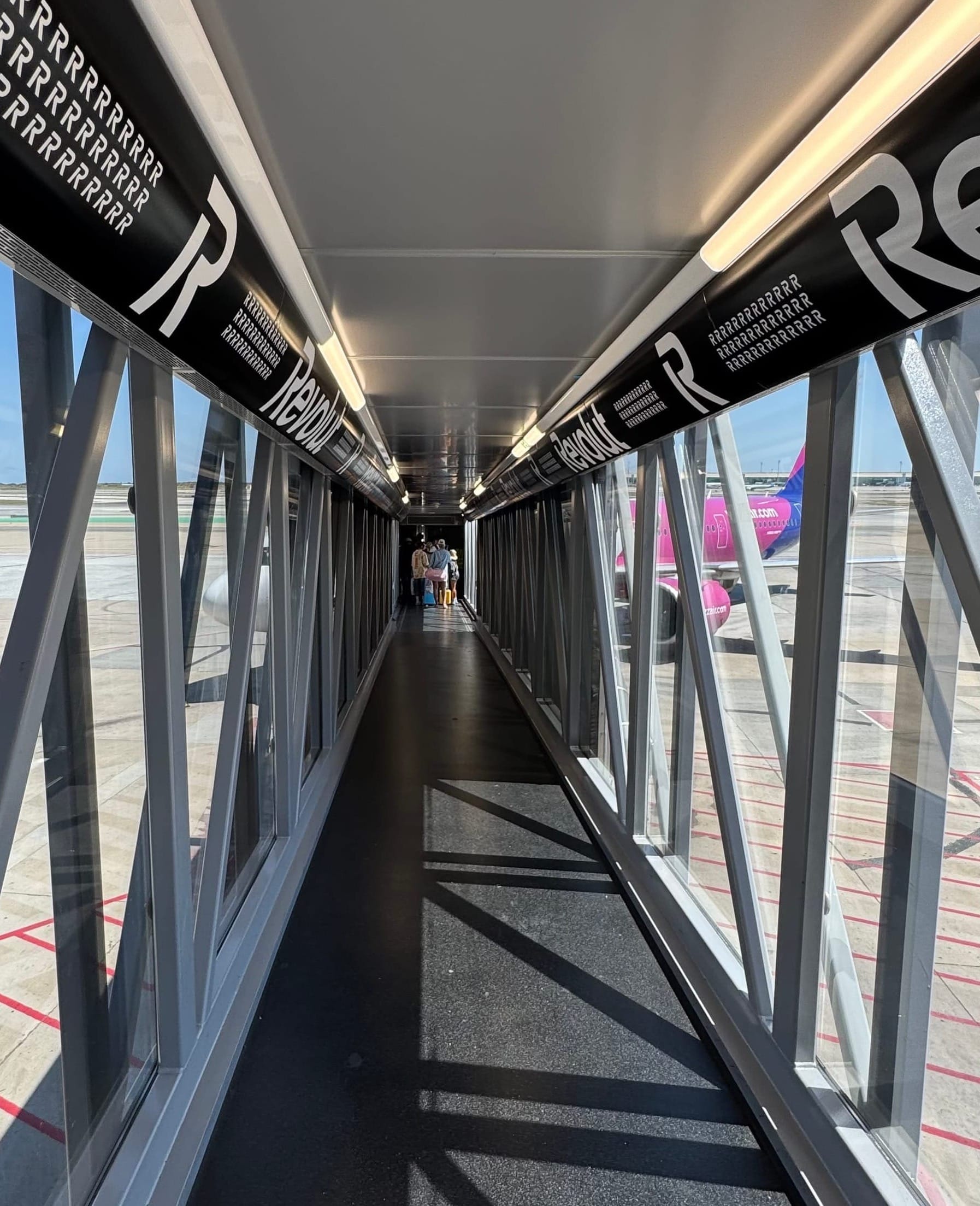
El Prat has taught me patience with taxiing. It can take twenty minutes. Sometimes more. Move, stop, turn, wait. Another aircraft. Another turn.
I have done it often enough that I can almost feel when we are finally getting close.
And yet there is one moment I have never managed to make mechanical.
The last wheels leaving the runway.
That is when I feel it in my stomach.
At the beginning, when moving between Poland and Barcelona was still new, my eyes would often fill with tears.
Now I usually look completely calm.
Inside can be another matter.
Sometimes I am fine. Sometimes I am not fine at all. Sometimes something inside me simply starts falling apart while my face remains almost expressionless.
That may be why people occasionally read me as someone who flies a lot or someone who lives here. They film the take-off, watch the city disappear, point things out to each other. I sit quietly.
But calm behaviour is not the same thing as emotional indifference.
I have simply learnt not to perform the experience outwardly.
For years, I often listened to David Bowie’s Space Oddity at take-off.
I have never told anyone that before.
It was just something I did.
Now the soundtrack changes. Sometimes it follows whatever musician I have become obsessed with recently. Sometimes I am still in the afterglow of a concert and continue listening to the same person for days.
But I still like to have music in my ears when the aircraft starts accelerating.
Then comes the dangerous part.
Not turbulence.
Thinking.
An airplane is an almost perfect machine for grinding thoughts into dust.
You are strapped into a seat for two and a half hours with nowhere useful to go. You cannot suddenly clean the kitchen. You cannot go for a walk. You cannot decide to run an errand. You cannot distract yourself with the thousand tiny movements that normally interrupt a train of thought.
And the subjects available for rumination are not always brilliant ideas for the next article.
Sometimes they are simply sad.
Leaving.
Missing someone.
The days ahead.
What is happening in the place you have just left.
What will happen in the place you are approaching.
A particular thought can get stuck and circle for an absurd amount of time.
So I have learnt to occupy my attention.
Years ago I would sometimes work on my laptop. I played offline games. I edited photographs. I did whatever could be done without an internet connection.
I still occasionally work, but airplanes are not always the magnificent productivity chambers people like to imagine. Someone is sitting centimetres away from your screen. A document does not have to contain state secrets for me to prefer not to have a stranger reading over my shoulder.
These days I usually download something onto my iPad.
Preferably something long enough to consume most of the flight.
Sometimes a film. Sometimes a few episodes of a series. Quite often something I already know.
I like rewatching things.
There is something comforting about a story whose rhythm is already familiar. It does not need to be prestigious cinema. It can be La Casa de Papel. It can be Berlin. It can be some ridiculous reality show. It just has to hold my attention.
Once I watched Interstellar on a flight and realised how much more I noticed than I had while watching it on the ground.
There was no tea to make.
No second screen.
No conversation.
No work opened in another window.
No domestic interruption.
Just the film.
Two hours of being forced to stay with one thing can produce an extraordinary kind of concentration.
But there is another reason I do it.
I do not watch things on planes because I need to kill time.
I watch them because otherwise the time starts working on me.
Put the iPad in front of me, give me two episodes that last around an hour each, and suddenly the aircraft is descending.
There is something almost childlike about it. Here is my screen. Here is my story. My attention has somewhere safe to go.
For two hours, I do not allow those two hours to eat me.
Around me, other passengers often inhabit an entirely different version of the same flight.
They are returning from Barcelona.
They scroll through photographs. They show each other things they saw. They reconstruct dinners, streets, beaches. During football season I used to see men comparing photographs from Camp Nou, still excited about the match.
Barcelona is becoming a story they are taking home.
There is nothing wrong with that excitement. I recognise it.
I am simply sitting on a different axis.
I am usually travelling alone.
And I am not really returning from Barcelona in the same way.
I am leaving home.
Temporarily.
And travelling home.
That is the part that is difficult to explain.
Poland is my first home.
My family is there. My work is there. My people are there.
I want to go back.
This is not a story about reluctantly returning somewhere I no longer belong.
But wanting to return to one home does not make leaving the other one painless.
And it works exactly the same way in reverse.
Leaving Poland is difficult too.
When I leave Poland, I leave my people.
When I leave Barcelona, I leave my person.
There is no easy direction on this route.
Someone could reasonably ask: if leaving is difficult every time, why keep doing it?
Because this is my life.
That is all.
People have different biographies. Mine happens to have two centres of gravity.
And perhaps that is where the anthropologist in me inevitably enters the story.
Airports are almost textbook examples of non-places: spaces built around movement, temporary identities and procedures. For a while we become passengers, passports, boarding passes, seat numbers.
They are also deeply liminal spaces.
You have left one place without yet entering the next.
For a few hours, you are neither here nor there.
El Prat complicates this for me because it has become so familiar.
I know where I am going. I know which parts of the terminal I like. I know where I would rather not sit. I even know which toilets I prefer, although perhaps that is a level of airport intimacy best left out of serious anthropology.
It is familiar without becoming a destination.
Still a corridor.
There is something faintly hyperreal about the whole thing too. After security, Barcelona survives in concentrated form: cava, jamón, souvenirs, polished fragments of local identity arranged for people who are already leaving.
The city becomes an edited version of itself.
Meanwhile I sit there eating a sandwich made in my kitchen.
Perhaps that explains the situation better than the theory does.
Then the gate opens.
The air bus takes me away.
And a few hours later I enter another version of my life.
Sometimes the strangest moment is not the flight at all.
It is the airport bus towards Katowice.
Everything is familiar.
I know the landscape.
I understand every word around me.
Nothing should feel foreign.
And yet sometimes I do.
Not because Poland has stopped being mine.
Because Barcelona has become mine too.
Then the absences begin announcing themselves.
Cava. Usually Freixenet.
Vermouth.
Tapas.
Pulpo.
The rhythm of the streets.
Even the thick, sticky Barcelona summer air I complain about while I am living in it.
Absence is very good at transforming ordinary things into signs of home.
And then, some days or weeks later, I do the entire sequence again in the opposite direction.
The sandwich.
The backpack.
Security.
The gate.
The aisle seat.
The music.
The iPad.
The same attempt to reduce uncertainty to zero.
And the same impossibility of reducing what happens inside me.
Sometimes, after landing in Barcelona, the cabin crew makes the usual distinction.
Those visiting the city are wished a pleasant stay.
Those returning from a journey are welcomed home.
It is an ordinary airline announcement.
Probably barely noticed by most people.
It still gets me.
Because I know exactly which part of that sentence is addressed to me.
I have two places I return to now.
Maybe that is why I no longer really think of these flights as journeys.
They are the space between my people and my person.
The corridor between two homes.
By Airbus.