Eclipse Fever, Minus the Apocalypse
For several days before the solar eclipse, there seemed to be considerably more eclipse than there was ever going to be actual eclipse.
There were traffic warnings. Roads that might be closed. Car parks that might fill up. Advice to arrive early. Questions about where to go, when to leave and how long it might take to get home afterwards.
There were special glasses, weather forecasts and, inevitably, photographic FOMO.
Should I buy a solar filter for my camera?
It was, after all, a rare opportunity. Perhaps the only one.
I decided not to.
This was not because I wasn’t excited about the eclipse. Quite the opposite. I love astronomical phenomena. I had seen a partial solar eclipse before in Poland, but never totality.
I absolutely wanted to see it.
What I was much more sceptical about was everything humans were constructing around it.
Catalan News called it “eclipse fever”, which seemed increasingly accurate. The eclipse had become a social event long before the Moon crossed the Sun. People talked about it in shops. Newspapers discussed viewing locations. Some people travelled specifically to Catalonia to see it. On the road south, we noticed plenty of French number plates.
And yet eclipse fever did not mean that everybody had suddenly reorganised their life around the sky.
Not everyone has a car. Not everyone wants to drive a hundred kilometres in search of a better position inside the path of totality. Plenty of people stayed in Barcelona and watched from there. Some apparently did not care very much at all.
After the eclipse, I saw people casually walking their dogs.
The Moon may have been crossing the Sun, but somebody still had to take the dog out.
Preparing for something that hadn’t happened yet
My expectations were considerably worse than what eventually happened.
I imagined serious traffic jams. The kind where you start wondering whether you should have left three hours earlier, whether there will be anywhere to park by the time you arrive and whether the return journey will consist of staring at the same bumper until midnight.
I also started thinking about food.
Should we take something substantial? What if we got stuck for hours? What if we came back very late?
At some point I realised that I was mentally preparing for an astronomical event as if it might also involve a minor evacuation.
In the end, we kept it simple.
I had already bought proper eclipse glasses from an optician. We took our Polarbox with ice packs, cold drinks and a few snacks for the road. Peanuts, protein bars, something sweet, a Red Bull.
The Polarbox turned out to be one of the most useful things we brought.
August in Catalonia is hot, the journey was long, and being able to take out genuinely cold water or another drink from the car was wonderful. Chocolate stayed chocolate instead of becoming a new state of matter.
But we did not need an entire travelling kitchen.
The sweet potato fries I had made earlier were eaten before we left. The Greek salad stayed at home. We were going to see an eclipse, not survive a siege.
The camera came with me.
The solar filter did not.
And afterwards, I did not regret that decision for a second.
Photographic FOMO is particularly efficient: This may never happen again. How can you possibly not have the right equipment?
But what I actually wanted to see was totality.
I did not need a technically complete photographic sequence of the Moon gradually eating the Sun simply because the opportunity existed.
Sometimes being there is enough.
South to Tarragona
We left Barcelona at around 4:30 p.m. and headed towards Tarragona and the Anella Mediterrània.
Under normal conditions, the drive should have taken roughly an hour and a half.
Instead, it took us more than two hours.
There was traffic. At times, quite a lot of it. But there is an important distinction between congestion and being completely trapped in a stationary queue.
Most of the time, we were moving.
Sometimes slowly. Sometimes very slowly. Occasionally we stopped. At one point the navigation showed us crawling at around 20 kilometres per hour on a motorway where the limit was 120.
Waze probably saved us from something much worse. It rerouted us twice, steering us away from congestion that looked considerably heavier elsewhere.
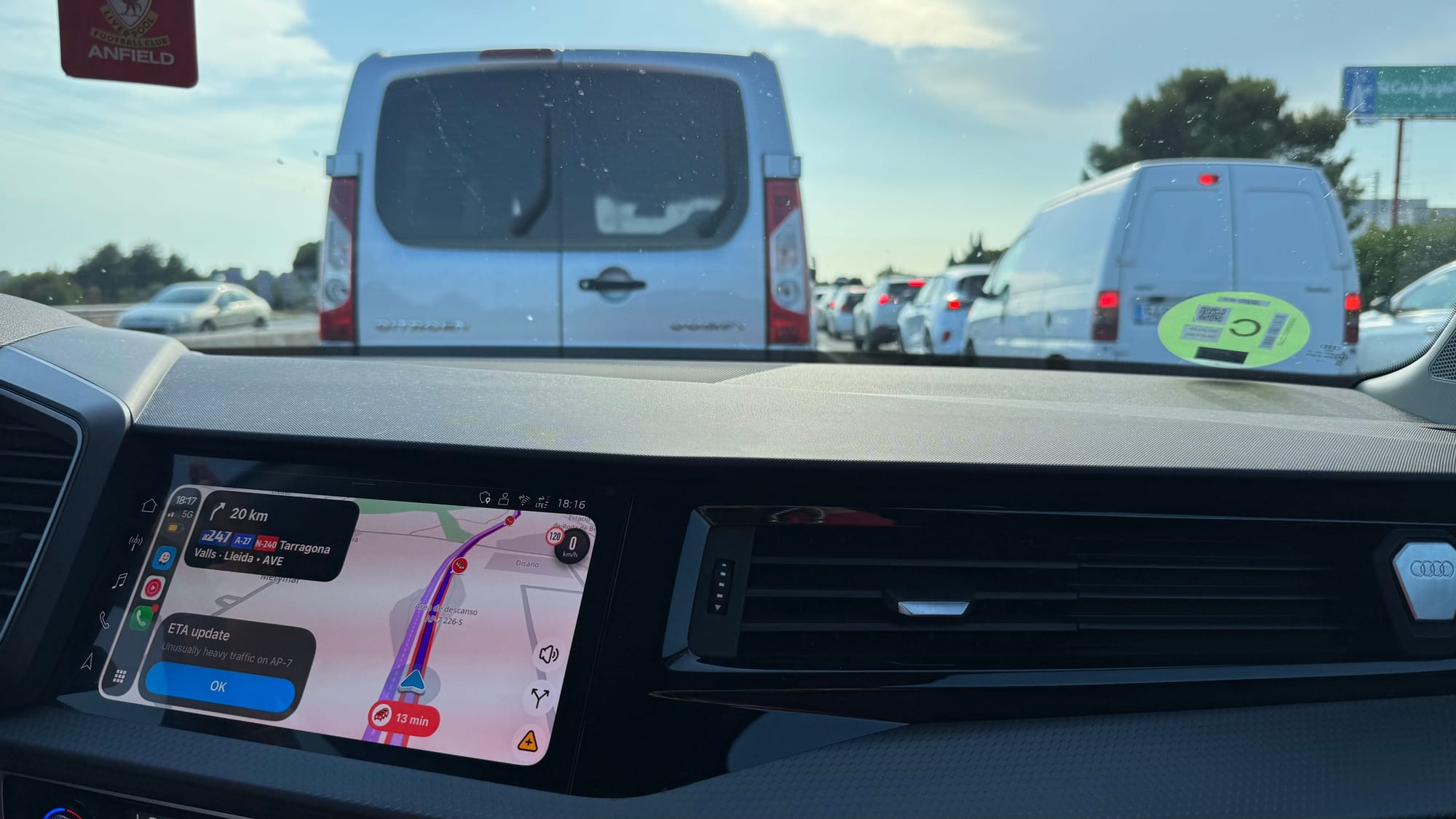
And at one point we saw exactly what the alternative could look like.
The exit towards Altafulla was extraordinary.
The queue was enormous. Even from our road it looked sufficiently apocalyptic for Javi to immediately say how glad he was that we were not going there.
That became a useful lesson in eclipse traffic.
There was no single “eclipse traffic”.
One destination could be manageable while another exit only a few kilometres away looked like the evacuation scene from a disaster film.
Despite all my earlier anxieties, no dramatic road closure destroyed our route. Nobody redirected us. Nobody told us we could not get through.
And when we finally reached the Anella Mediterrània shortly before 7 p.m., parking was almost comically easy compared with what I had imagined.
We could probably have parked directly at the sports complex. Instead, we found a normal marked space nearby.
There was still plenty of time to walk to the viewing area, find the toilets, look around and sit down.
No running.
No panic.
No last-minute battle for a patch of grass.
A surprisingly intimate eclipse
This was probably my favourite contradiction of the entire day.
The roads suggested a mass event.
The viewing site felt almost intimate.
There were plenty of people, but it never felt overcrowded. Families and groups of friends sat on blankets. Some people had folding chairs and umbrellas. Someone had a telescope. Others had cameras and more serious observational equipment.
There were toilets.
And that was basically the infrastructure.
No food trucks where we were. No eclipse merchandise. No commercial village built around the sky.
People simply came, found a patch of grass and waited.
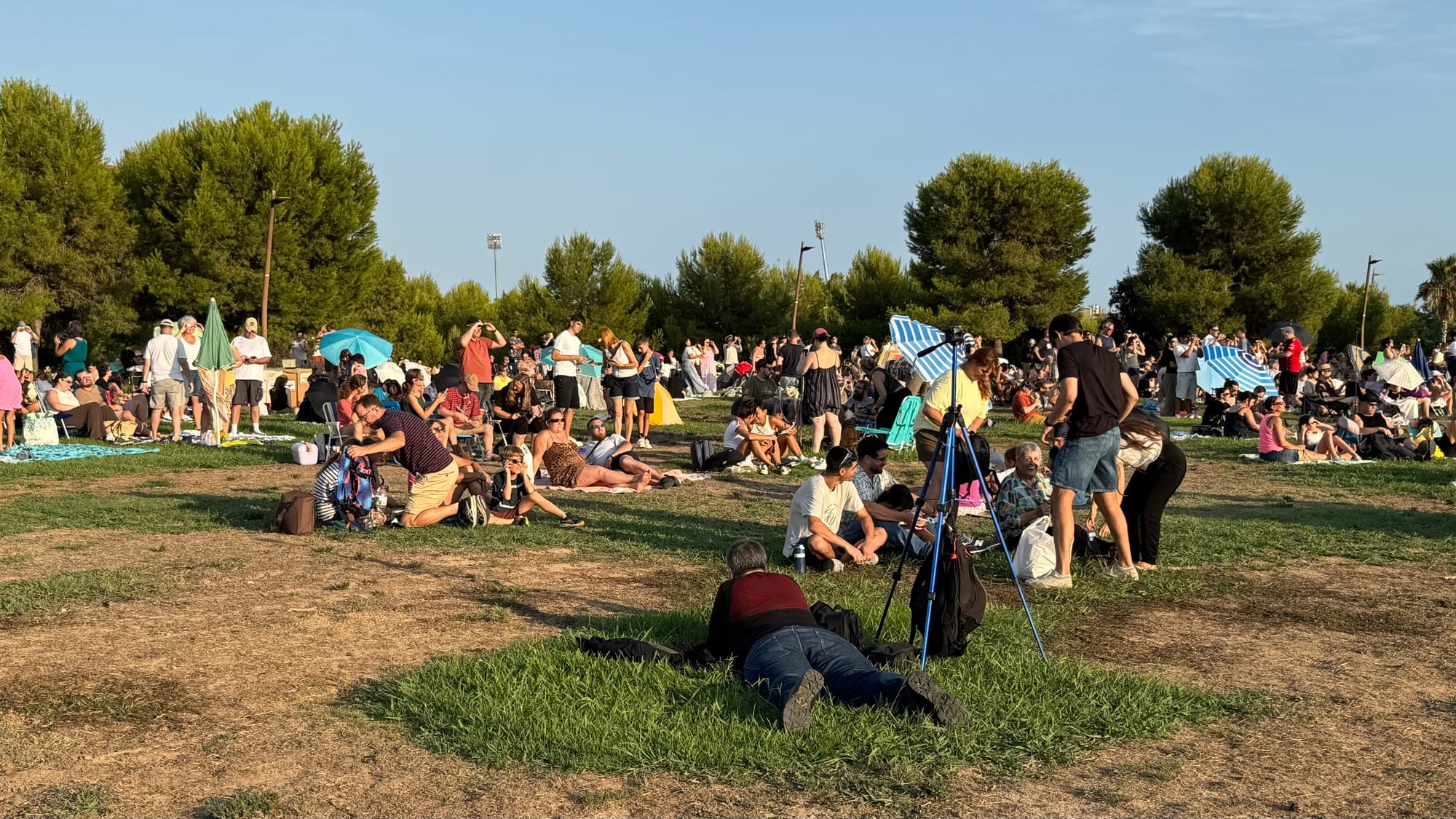
It felt less like a mass event than an enormous summer picnic organised by celestial mechanics.
And there was time.
The partial phase progresses slowly enough that watching it becomes almost ritualistic. You put on the glasses, look at the solar disc, take them off again. A few minutes later, you check once more.
The Moon has moved a little further.
At first, everything around us still looked like an ordinary late-summer evening.
People talked. Ate. Lay on the grass. Children moved between blankets. Somebody adjusted a telescope.
Meanwhile, I kept checking the time.
Fifteen minutes.
Ten.
Five.
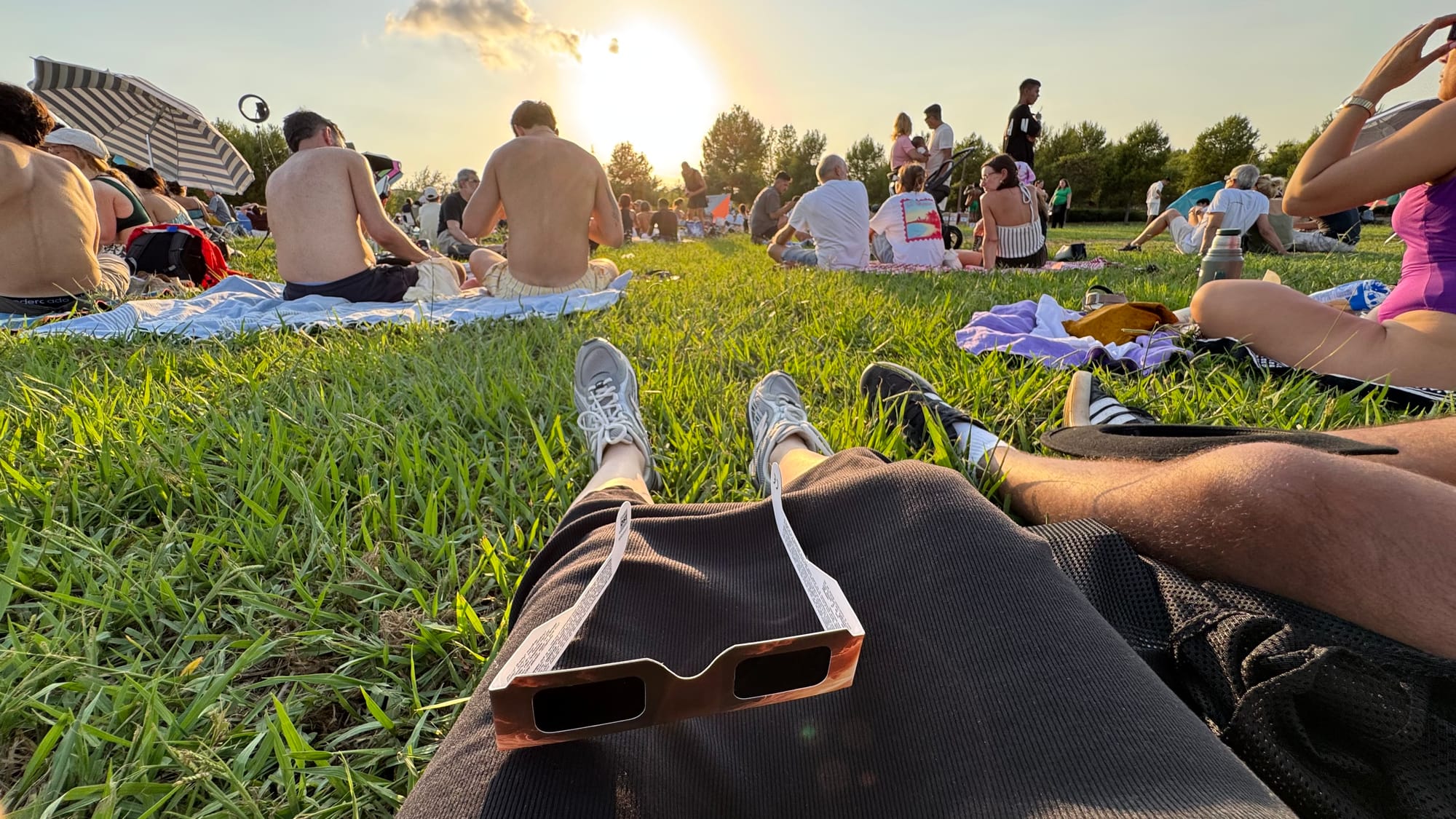
Glasses on. Look at the Sun. Glasses off. Check the time again.
The Moon kept taking another small bite.
Then the light began to change.
And people began paying more attention.
One minute
As totality approached, the atmosphere shifted.
Conversations became shorter. More people were looking up.
And when it started, people around us began to applaud.
After all the discussion, warnings, shopping, driving, route changes and imagined disasters, there was suddenly nothing left to prepare for.
You just looked.
We sat there on the grass, holding hands, watching the Moon finish covering the Sun.
Most of the time, that is exactly what I did.
I looked.
Because there are moments when documenting something becomes less important than letting it enter your nervous system properly.
Totality in Tarragona lasted only about a minute.
A minute sounds short.
It feels much shorter.
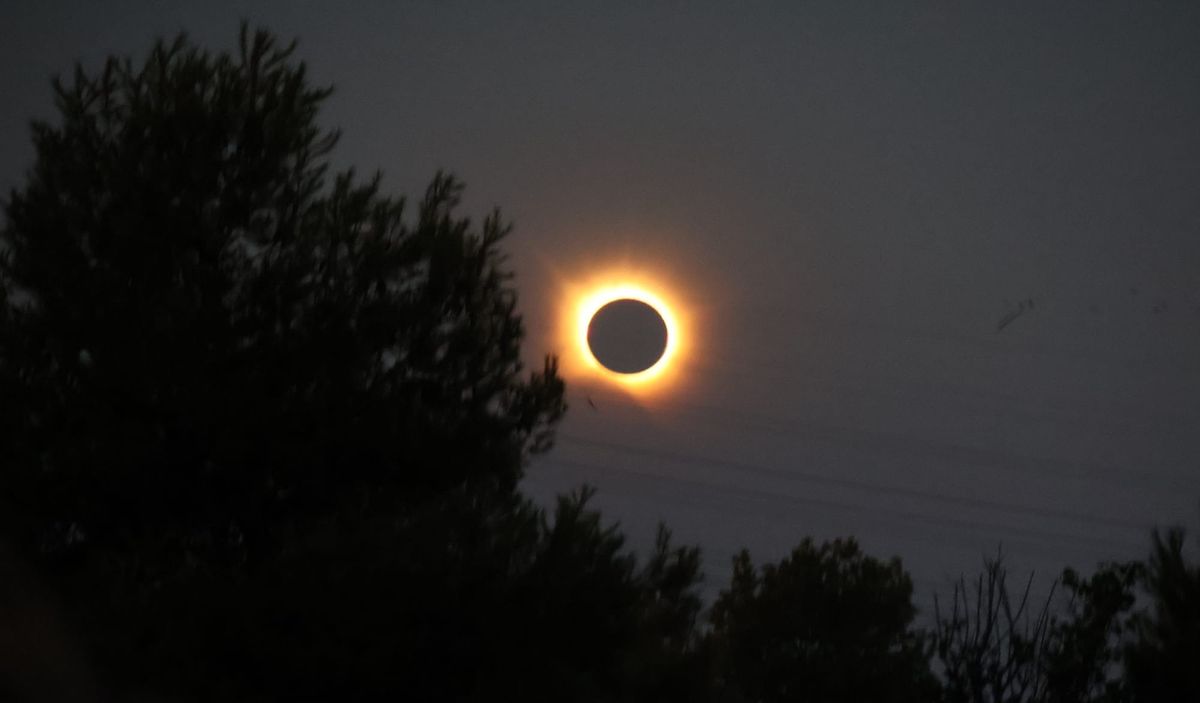
The entire experience seems to accelerate the second it arrives. The landscape changes. The light becomes unfamiliar. The Sun disappears behind a black disc and something you have seen in thousands of photographs suddenly exists above your own head.
You know perfectly well what is happening.
The Moon is between you and the Sun.
There is nothing mysterious about the mechanism.
And yet visually it looks completely impossible.
I had my Canon with me and photographed the eclipse at 150 mm. At some point I ended up kneeling on the grass, which became obvious afterwards from the state of my knee.
But the camera was not the centre of the experience.
Near the end of totality I became distracted for a moment.
Then Javi suddenly told me the diamond ring was beginning.
That was how quickly the minute had disappeared.
I managed to catch it.
And yes, I cried a little.
Not because all the eclipse fever had suddenly become profound.
Because the eclipse itself was beautiful.
I had seen a partial solar eclipse before.
It is not the same thing.
Not even close.
Then the light began to return.
And almost immediately, the event everybody had spent so much time talking about was over.
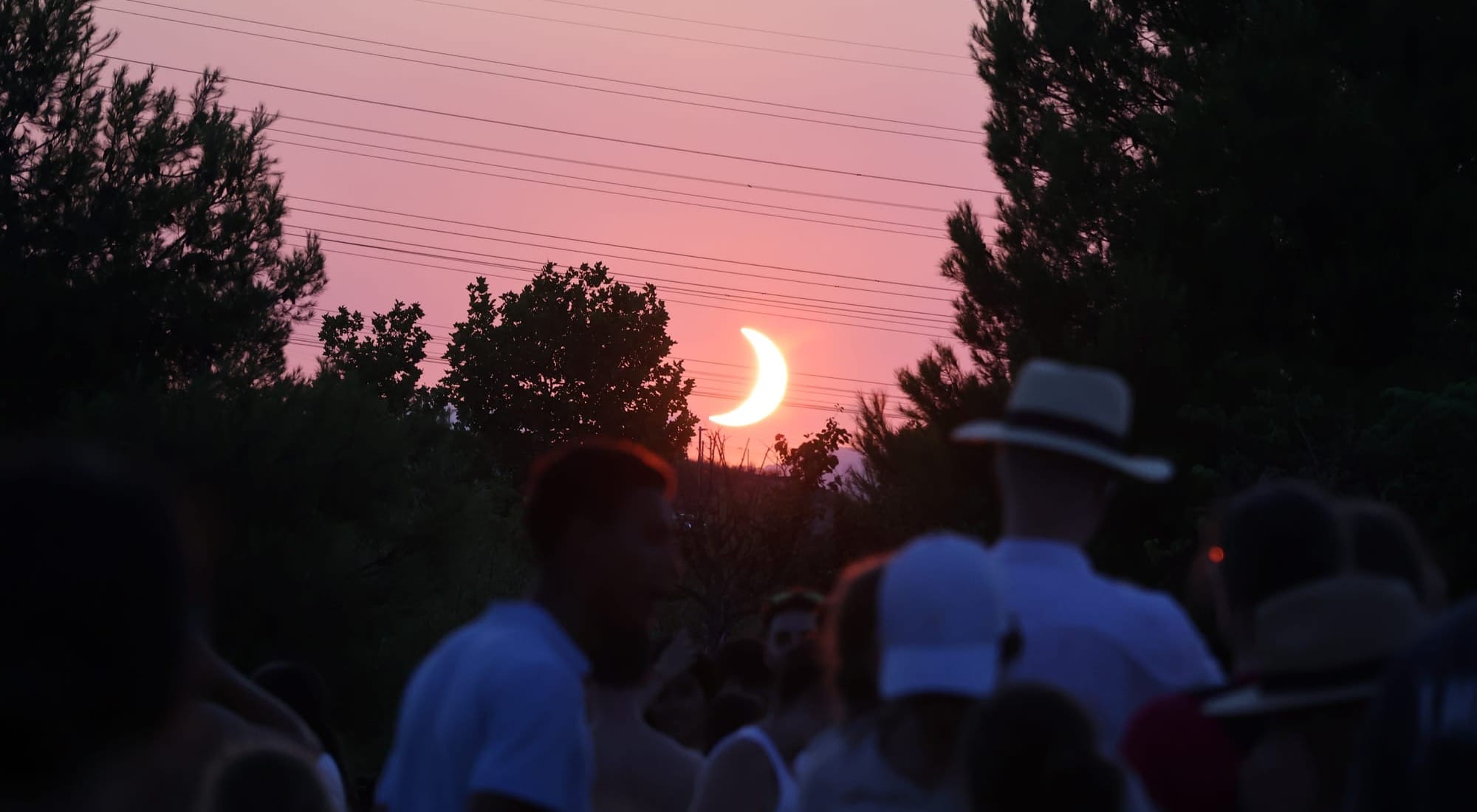
Everybody goes home
We started leaving before the very end of the entire partial phase.
Some people were still sitting on the grass, but we thought it might be wise to get moving before absolutely everybody decided to do the same.
That probably helped.
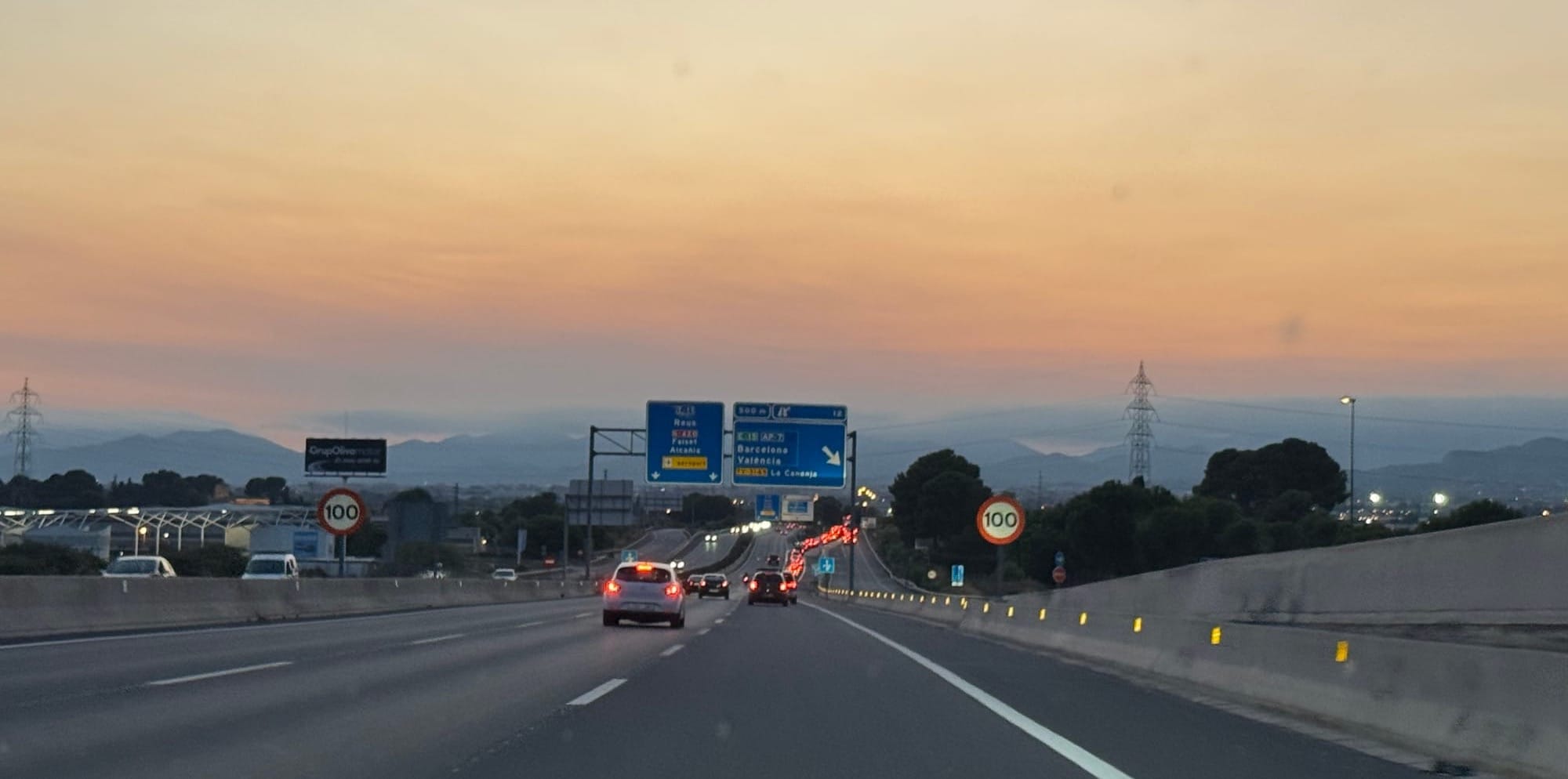
The return to Barcelona was nevertheless clearly worse than the drive south.
This was where the logic of the event finally became obvious: people could arrive throughout the afternoon, but once the main spectacle was over, many of them wanted to travel home at roughly the same time.
Traffic moved in waves.
Sometimes we were travelling at around 50 kilometres per hour. Sometimes 20 or 25.
At one point Javi pointed at the motorway speed limit — 120 — and then at our actual speed.
Twenty-something.
Sometimes we stopped completely, but never for some endless half-hour stretch. The road would compress, release us, slow down again and then begin moving.
It was stop-and-go rather than gridlock.
The toll area produced one of the most spectacular images of the return journey: lanes full of cars and an entire landscape glowing red with brake lights.
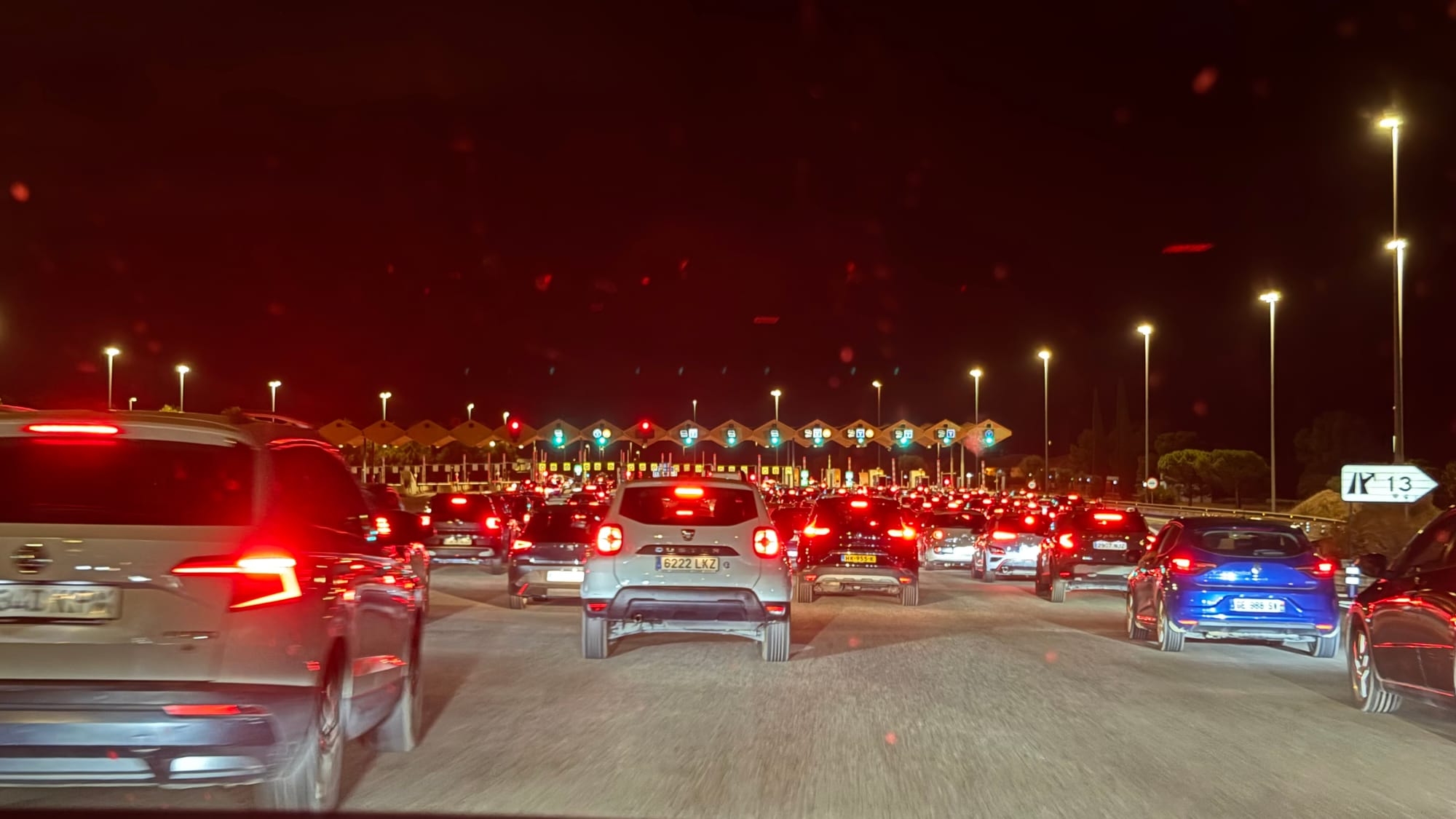
But again, it was not the motionless apocalypse I had imagined before leaving Barcelona.
It was heavy traffic, bottlenecks and a very long journey home.
Annoying at moments.
Slow, certainly.
But manageable.
And this was where our modest preparation paid off again. Cold water, cold drinks, something small to eat. No need to start looking for food somewhere on the road.
The things I had packed were useful.
The catastrophe I had half-prepared for never arrived.
Fever versus reality
So, was the eclipse fever justified?
Partly.
There really were crowds on the roads. Some destinations clearly had it considerably worse than we did. Some people travelled internationally. Traffic was heavy enough to turn an ordinary journey into a very long one.
But there was also a strange gap between the intensity of the anticipation and the simplicity of the event itself.
For days, the eclipse existed as logistics.
Traffic.
Parking.
Equipment.
Glasses.
Weather.
Photography.
FOMO.
Then we arrived.
People sat on the grass.
Someone had a telescope.
Someone opened a picnic.
The Moon slowly moved across the Sun.
People applauded.
And for about a minute, everybody looked up.
That was it.
And it was extraordinary.
So yes, I remain slightly sceptical about eclipse fever.
Humans are exceptionally good at generating days of anxiety, consumer decisions and logistical speculation around an astronomical event that does not particularly care whether we are ready for it.
But I am also very glad we went.
It was the first total solar eclipse either of us had ever seen.
We drove for hours for roughly one minute of totality.
I cried.
Javi caught the moment when I almost missed the diamond ring.
And we will remember that evening for the rest of our lives.
The apocalypse?
Thankfully, mostly imaginary.