Frankfurt Is Not What I Thought It Was

The first time Javi asked if I wanted a frankfurt, I didn’t think about hot dogs.
I thought about Germany.
More specifically, Frankfurt am Main. Frankfurter sausages. German food.
Growing up in Silesia, those associations felt completely natural. German names, recipes and culinary traditions never seemed particularly distant to me. My family has German roots, and I knew what a Frankfurter sausage was.
Or at least I thought I did.
Javi wasn’t talking about Germany.
He wasn’t talking about a city.
He was pointing at a small hot-dog stand near the harbour.
‘Do you want a frankfurt?’
Only then did I realise that, in Catalonia, frankfurt could mean the thing being sold from that kiosk: a sausage in a bun, ordered with the casual confidence of someone who saw absolutely nothing linguistically remarkable about it.
I declined. I do not particularly like hot dogs, and the addition of ketchup and mayonnaise did nothing to improve the proposition.
The word, however, stayed with me.
Then I started seeing Frankfurt everywhere
Strictly speaking, the first place that really caught my attention was not called Frankfurt at all.
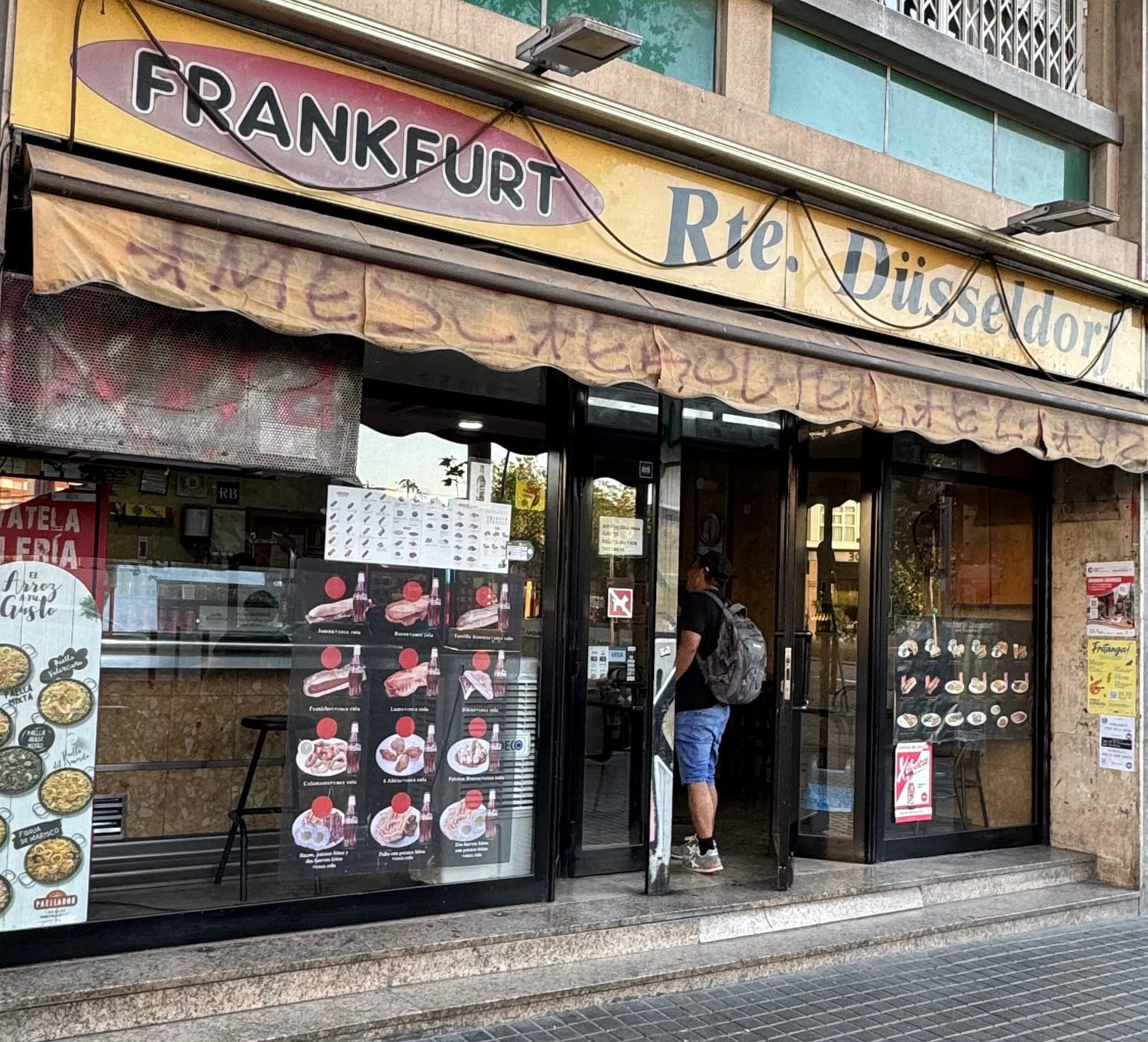
It was called Düsseldorf.
The bar stands on Avinguda del Paral·lel, on one of our usual walking routes towards the port and on the route I often take when running to Barceloneta. I noticed the name immediately. Of course I did. It was a German city transplanted onto the façade of an ordinary Barcelona bar.
Soon, Düsseldorf became one of my recurring jokes with Javi. I wanted to walk inside, address the owner in German and ask whether he had family in North Rhine-Westphalia. Had he ever visited Düsseldorf? Was there a story behind the name? Had the sign made a promise that the establishment was prepared to honour?
Javi did not understand why any of this was funny.
To him, Düsseldorf was simply the name of a bar.
To me, Barcelona suddenly looked as though somebody had quietly borrowed fragments of Germany and converted them into places serving sausages, sandwiches and beer.
Once the question had lodged itself in my mind, Frankfurt began appearing everywhere.
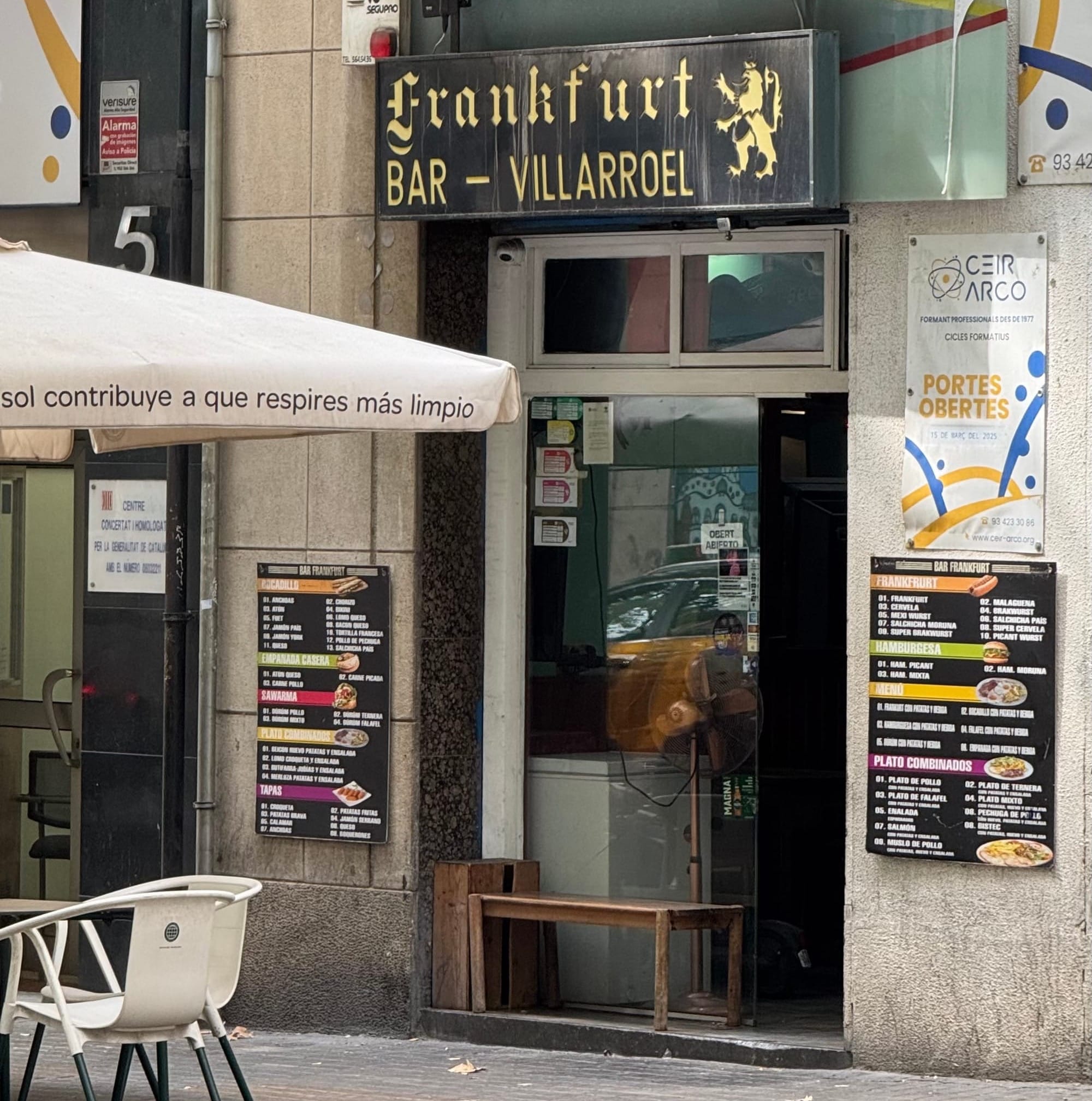
There was Frankfurt Bar Villarroel, barely a minute from our flat.
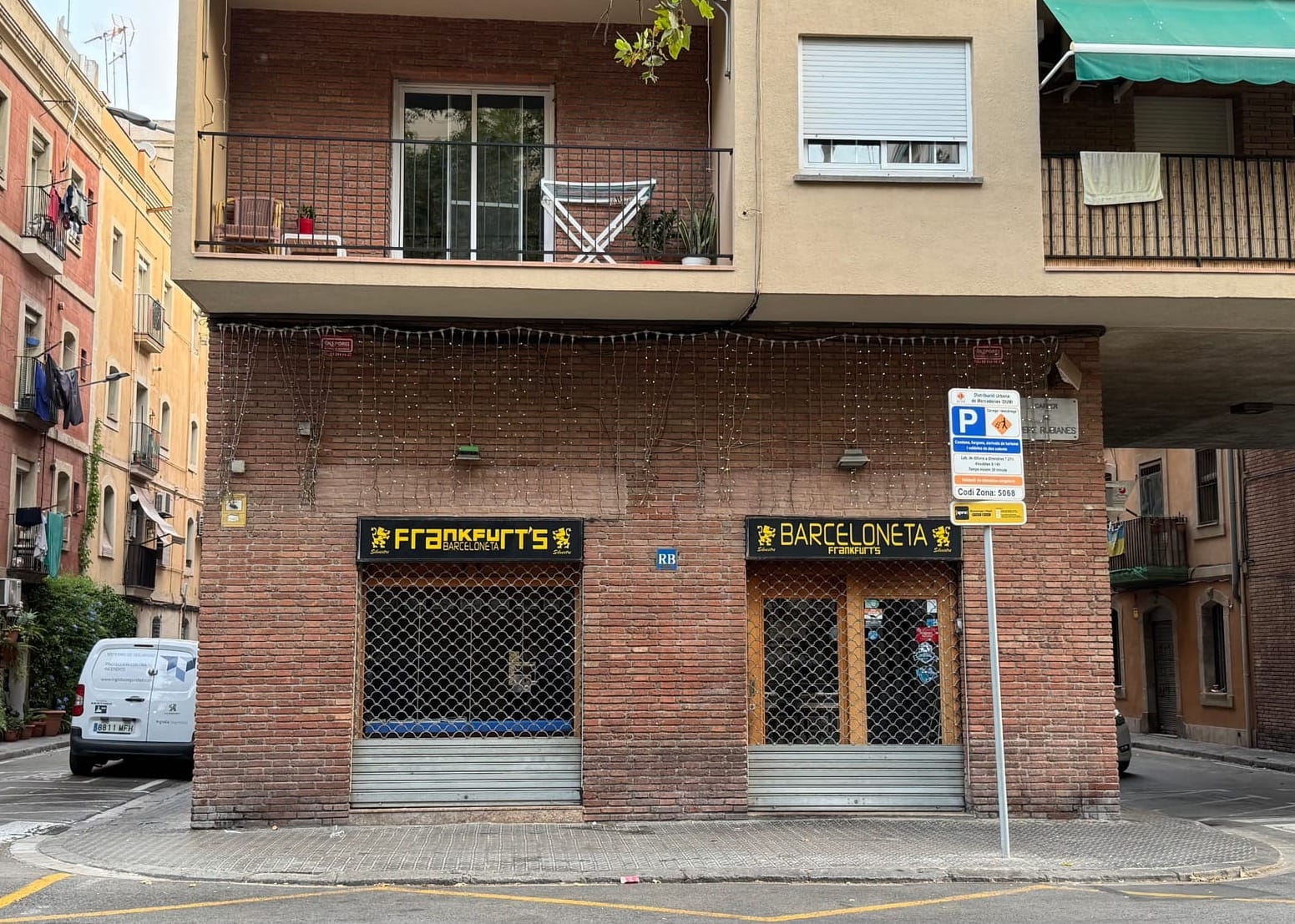
There was Frankfurt’s Barceloneta.
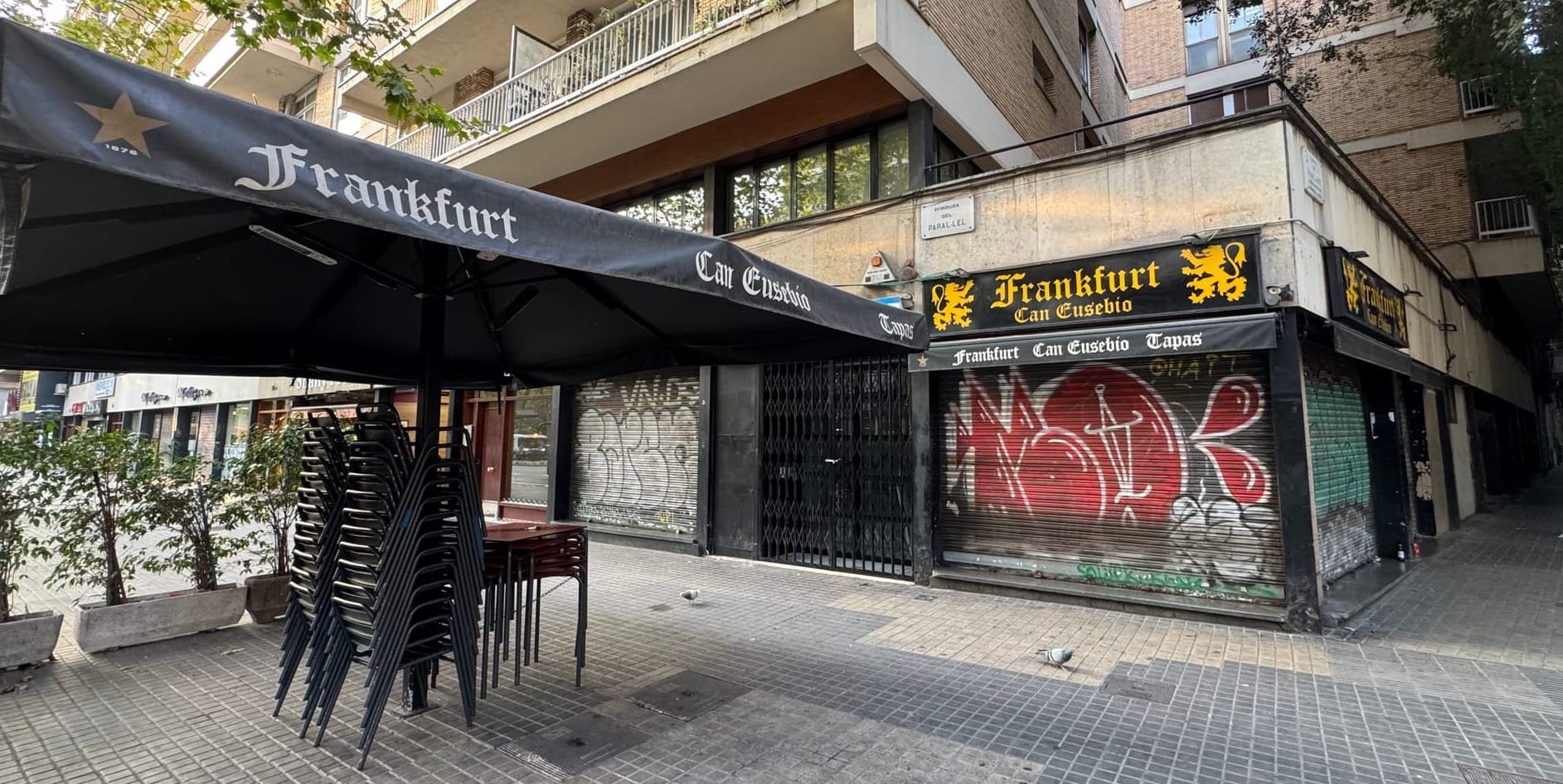
There was Frankfurt Can Eusebio on Paral·lel.
Then the map began to escalate.
Frankfurt Berlin.
Frankfurt Paris.
Frankfurt Londres.
Frankfurt Munich.
Frankfurt Zürich.
Even Frankfurt Lübeck, because apparently the obvious European capitals were no longer enough.
At first, the names reminded me of the code names in La Casa de Papel: Paris. London. Berlin. Except here they belonged to sausage bars. The joke became even better when I realised that some of them weren’t random at all. Frankfurt Paris sits on Carrer de París. Frankfurt Londres on Carrer de Londres. Others are named after neighbourhoods, owners, or something else entirely. There doesn’t seem to be a single rule.
Google had other ideas
Naturally, I started investigating in the most obvious place.
I opened Google and typed:
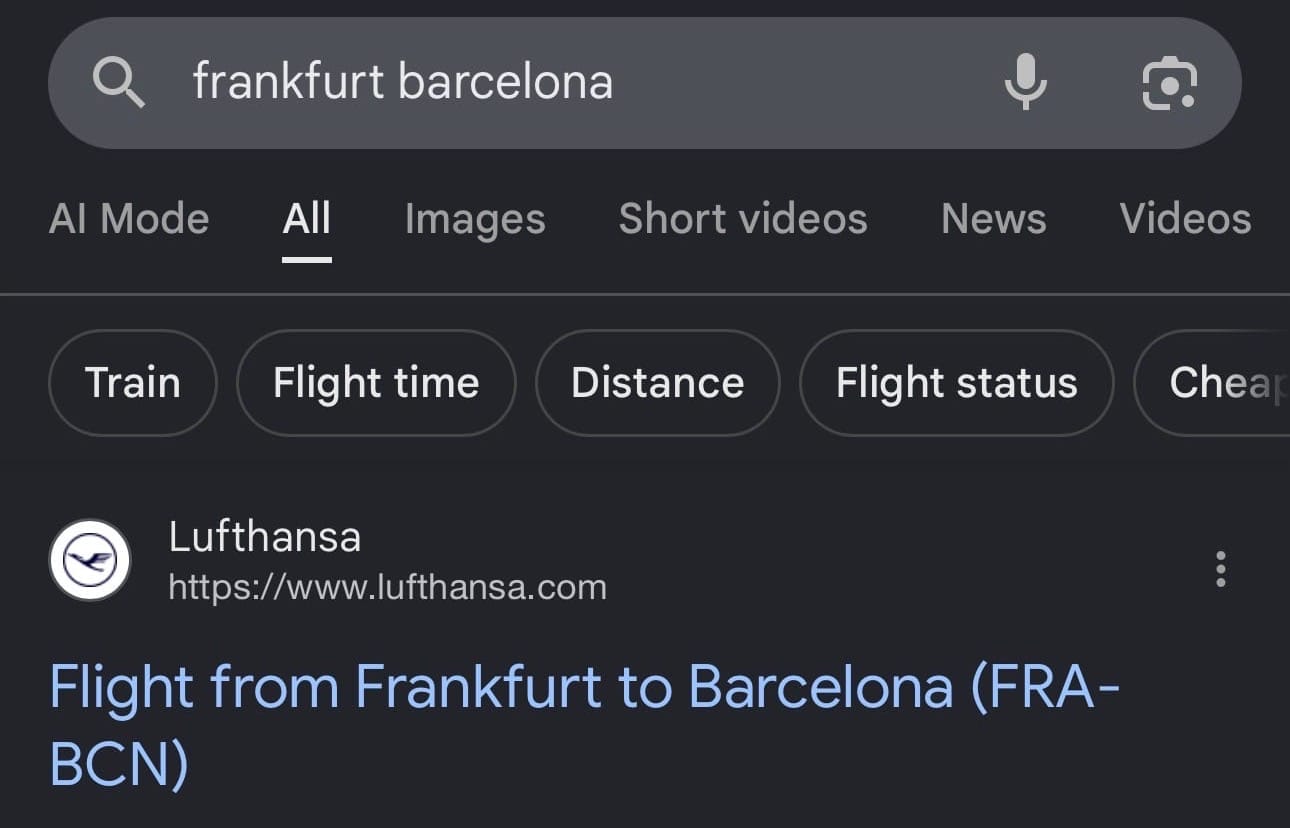
Frankfurt Barcelona.
Google offered me flights from Frankfurt to Barcelona.
Fair enough.
I tried Google Maps. I wanted the equivalent of ‘all locations’, the way one might search for every Carrefour, Consum or VivaGym in the city.
Google Maps politely explained how to travel from Frankfurt am Main to Barcelona. By plane. By train. By FlixBus. One suggested railway journey would take more than fourteen hours.
Apparently, locating a neighbourhood hot-dog bar required crossing Europe.
I became more specific:
Frankfurt Paral·lel.
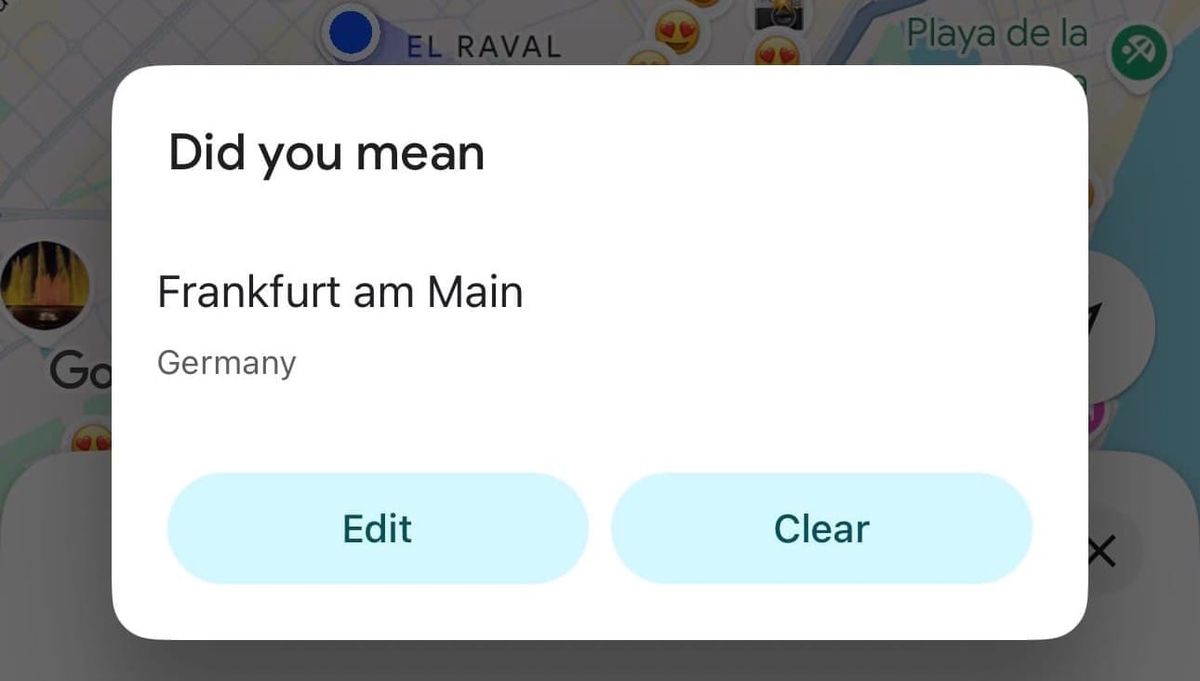
Google asked whether I meant Frankfurt am Main.
I tried combining Frankfurt and Düsseldorf. Google responded with streets and hotels connecting the two German cities, as though it had decided that my geographical confusion required immediate intervention.
The algorithm remained firmly convinced that Frankfurt could mean only one thing.
Barcelona disagreed.
Eventually, by adding bar, neighbourhood names and increasingly desperate combinations of search terms, the local Frankfurts began to emerge. But they appeared among travel routes, German hotels and transport options, as if the city’s everyday gastronomic vocabulary had slipped through a crack in the search engine’s understanding of the world.
That failure was funny, but also revealing.
For Google, Frankfurt was primarily geography.
For many people in Catalonia, it was also food, a menu category and a type of local establishment.
The same word was organising two entirely different realities.
So how did a German sausage become a Catalan institution?
The historical trail begins with German charcuterie in Barcelona.
Accounts of the Catalan Frankfurt tradition usually return to Máximo Zander Altmann, a German master butcher who arrived in Barcelona in the early twentieth century and produced German-style sausages under the name Max Zander. Some sources date his arrival to 1912, while the present-day brand itself uses 1921 in its identity. The exact chronology becomes slightly slippery depending on whether one is discussing Zander’s arrival, the beginning of production or the formal history of the brand. The broad outline, however, is consistent: German sausage-making entered Barcelona’s commercial food culture long before the Frankfurt bar became an established urban format.
The next decisive chapter belongs to the Vallès family of Terrassa.
During the mid-twentieth century, the family sold sausage sandwiches at travelling fairs, including summer fairs along the Maresme coast. What began as mobile fairground food eventually became a permanent business. Casa Vallès dates its history to 1963 and presents itself as the first Frankfurt in the country.
The innovation was not simply putting a sausage inside bread.
It was the entire format.
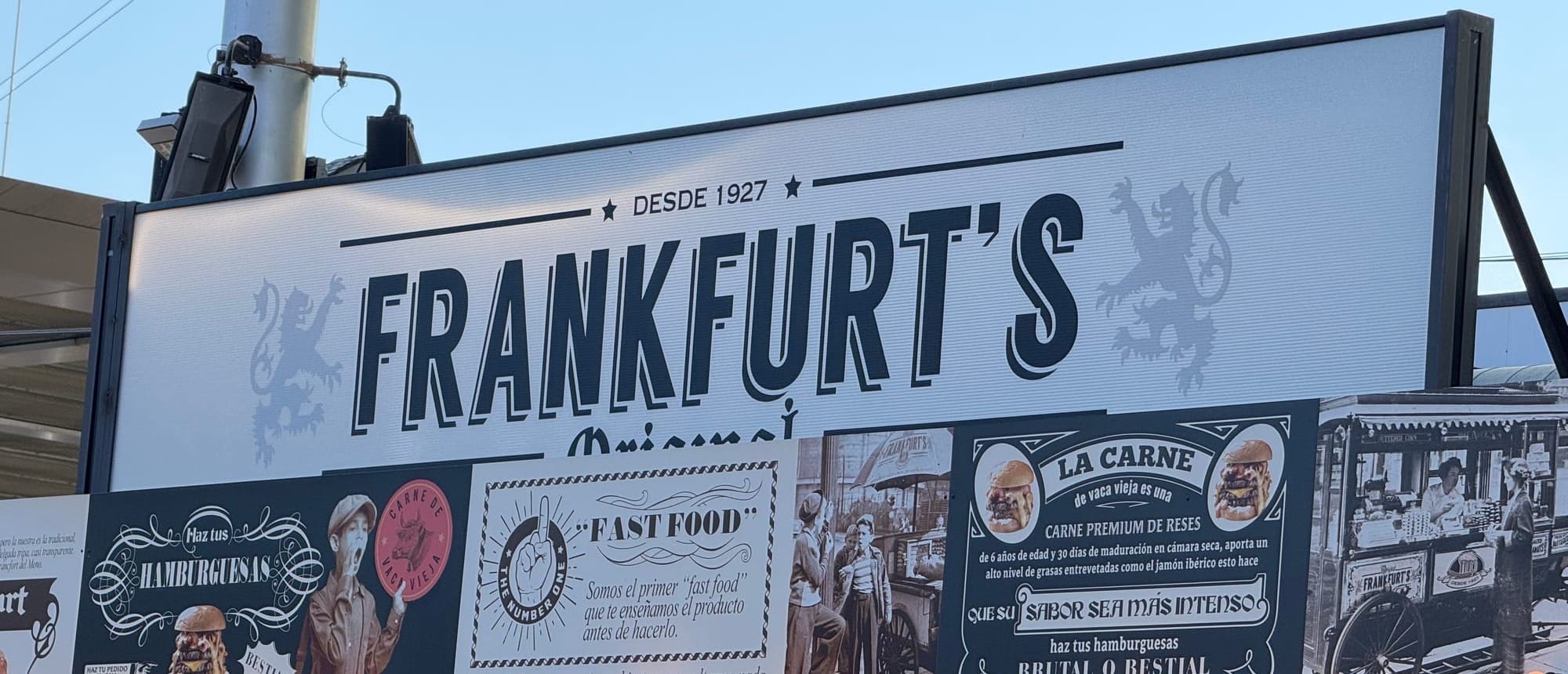
Quick service. Food prepared visibly on the grill. Beer. A counter rather than a formal dining room. A comparatively inexpensive meal that could be eaten without the rituals of a conventional restaurant. In the 1960s, this represented a distinctly modern way of eating. Contemporary accounts also emphasise the visual atmosphere: Bavarian fantasy, pale wood, stained glass and Gothic lettering. The German reference was not confined to the sausage; it was staged through the interior and the sign above the door.
The model spread through Catalonia.
By the 1980s and 1990s, Frankfurts had become so common that one account recalls finding one every few blocks. Casa Vallès itself developed establishments in Terrassa, Barcelona and Badalona, while countless independent owners adopted the category without joining a single franchise.
That last point matters.
There is no universal Frankfurt corporation whose branches can be revealed by pressing ‘all locations’.
Frankfurt is not one brand.
It is a type.
The sausage gave its name to the sandwich. The sandwich gave its name to the place specialising in it. Eventually, the place became familiar enough to function as a local cultural category.
The word travelled from product to premises.
History explained the origin — but not the meaning
At first, this seemed to solve the mystery.
German butcher. Sausages. Fairground sandwiches. Casa Vallès. Expansion across Catalonia.
Except it did not quite solve it.
History explained why the word arrived.
It did not fully explain what the word means in Barcelona now.
A vermutería gives you a reasonably clear clue: vermouth will matter.
A cervecería points towards beer.
A churrería announces churros.
A bodega carries its own historical associations with wine, storage, traditional drinking and food.
And then there is a Frankfurt.
The sausage remains central, certainly. But the category has expanded far beyond one product.
This is where the distinction between a sign and what it signifies becomes useful — even without turning the article into a semiotics lecture.
The word Frankfurt is visible on the façade.
But what, exactly, does it point to?
A German restaurant?
Usually not.
A hot-dog stand?
Sometimes, but not necessarily.
A bar?
Yes, although some use bar, others cervecería, and at least one manages to combine Frankfurt with churrería. Some write Frankfurt, others Frankfurts, and some attach the name of a city, neighbourhood or owner.
The sign remains stable enough to be recognised.
The reality behind it is flexible.
Learning to recognise a Frankfurt
The visual code was the next thing I noticed.
Many Frankfurts do not merely use the same word. They seem to belong to the same graphic family.
The exact details vary, but certain elements recur with suspicious regularity:
dark backgrounds;
yellow, gold or white lettering;
typefaces inspired by Gothic or blackletter scripts;
heraldic imagery;
lions flanking the name;
a vague Central European atmosphere.
Not every example contains every element. Frankfurt Zürich uses a more modern stylised typeface, but still relies on yellow, black and two heraldic lions. Others embrace Gothic lettering so enthusiastically that the German reference becomes impossible to miss.
The signs are not identical. They are variations on a recognisable visual vocabulary.
The fascinating part is what happens after you have seen several of them.
At first, Frankfurt is only a word.
Then you begin recognising the type of place before you have properly read the sign.
The black façade, the yellow lettering, the heraldic animals and the menu boards outside begin to work together. They create an expectation.
You know approximately what kind of establishment you are looking at.
That is how a cultural code works.
Nobody needs to stop you in the street and explain it. The city teaches it through repetition.
One sign means very little.
Ten similar signs become a language.
The sausage is the core
The menus confirmed that there was a shared centre but no rigid formula.
The sausage is the core.
Around it, everything else grows.
You will probably find a classic frankfurt, but also cervela, bratwurst, malagueña, chistorra, butifarra or other sausages. Then come hamburgers, bacon, lomo, chicken and bocadillos. Some menus continue expanding into patatas bravas, tapas, olives, calamari, croquettes, platos combinados, empanadas, shawarma, falafel, coffee and vermouth.
Frankfurt Barceloneta describes its own offer through the combination of frankfurts and tapeo, listing sausages alongside small plates, tapas and flautas. Casa Vallès offers products ranging from cervela and bratwurst to butifarra de perol, chorizo criollo and hamburgers.
The further I looked, the less useful ‘hot-dog bar’ became as a complete definition.
Not because hot dogs are absent. They are the historical and symbolic centre of the category.
But the Frankfurt has absorbed the ordinary repertory of the neighbourhood bar.
Coffee in the morning.
Beer during the day.
A bocadillo.
A hamburger.
Something from the grill.
Perhaps tapas.
The German element may remain more visible in some places than in others. One local may foreground Wurst, German sausages and German beer. Another may retain only the name, the lettering and a few sausage options while the rest of the menu looks completely Spanish or Catalan.
The imported element has not disappeared.
It has been naturalised.
What began with German charcuterie became Catalan everyday food.
The same sign, different rhythms
The opening hours made the category even more interesting.
My local Frankfurt in Sant Antoni opens at 7.30 in the morning.
Can Eusebio opens around 8.00.
Düsseldorf begins later, around 10.00, and later still on Sundays.
Frankfurt’s Barceloneta opens around midday.
The Frankfurt near Sala Apolo, which includes ‘Jazz Band’ in its gloriously overloaded name, opens in the evening.
The differences are not minor administrative details. They change the life of the place.
At my local Frankfurt, I often see people sitting outside when I walk to Consum or return from the gym. In the morning, they drink coffee from simple glasses and smoke cigarettes. Later, men sit with beer and do not necessarily appear to be eating anything at all.
The Frankfurt functions as a neighbourhood bar because the neighbourhood uses it as one.
Near Apolo, the rhythm is different. People can eat before a concert or a night out, presumably on the sensible principle that alcohol should not encounter an entirely empty stomach.
Barceloneta follows another timetable.
The category remains recognisable, but each establishment adapts to the temporal life surrounding it.
A Frankfurt does not impose one standardised rhythm on the city.
The city enters the Frankfurt.
This is where the comparison with McDonald’s becomes useful only up to a point. Both names create expectations before you enter. But McDonald’s attempts to reproduce the same experience through a franchise system. Barcelona’s Frankfurts do something more chaotic and more interesting: they promise a general kind of place while leaving individual owners free to interpret it.
You know approximately what to expect.
You do not know exactly what you will find.
Not designed for Instagram
Many of the Frankfurts I encountered also shared another quality.
They looked tired.
Not necessarily picturesque. Not necessarily charming in the carefully manufactured sense. Simply worn by use.
Their interiors had not been redesigned around pastel tiles, fashionable lighting and the possibility that every customer might photograph lunch from above. They looked like places that had been serving people for years and saw no urgent reason to reinvent themselves as lifestyle concepts.
This can attract tourists for precisely the same reason it repels others.
A visitor sees residents drinking coffee or beer in an unpolished neighbourhood bar and reads the scene as authenticity. Here, apparently, is the Barcelona that has not been staged for outsiders. The food is simple, often relatively inexpensive, and not accompanied by a paragraph about artisanal brioche and a chef’s personal journey towards mustard.
Reviews reflect the resulting collision of expectations.
One person praises the coffee and the waitress.
Another complains about hygiene.
One customer calls the food cheap.
Another calls it expensive.
Some celebrate a place full of locals. Others describe a tourist trap.
Düsseldorf sits at around 3.8 stars. My local Frankfurt, with only a few dozen reviews, manages roughly four. Can Eusebio has attracted harsher assessments and a much more dramatic relationship with its critics.
The owner of Can Eusebio sometimes replies politely: thank you for your feedback, have a good day, we will try to improve.
At other times, the replies become combative, ironic or spectacularly rude.
This is not the carefully sanitised language of corporate reputation management. There is no communications department producing variations on ‘We are sorry that your experience did not meet expectations’.
There is an owner, a keyboard and an opinion.
The digital personality of the place can be as unpolished as the physical interior.
The Frankfurt also exists online
By this point, my field had expanded beyond the street.
I was observing not only how the city used Frankfurts, but how Frankfurts were represented online.
Google Maps offered names, photographs, menus, hours and arguments.
Restaurant websites showed how owners described themselves.
Reddit showed how confused outsiders tried to translate the category.
One person asked why so many bars or bodegas in Barcelona were called Frankfurt. The uncertainty in the question was revealing: even the writer did not know what type of establishment they were looking at.
The common answer was simple:
A Frankfurt is a hot dog.
A Frankfurt bar is where you eat sausages.
That is not wrong.
It is simply where the interesting questions begin.
Why did the name of one sausage become the name of an establishment?
Why did so many independent businesses adopt the same visual code?
Why can a Frankfurt serve coffee at 7.30, beer in the afternoon, bocadillos, hamburgers and tapas, yet remain legible as a Frankfurt?
Why does the category feel entirely ordinary to Javi and faintly surreal to me?
And what happens when the digital map cannot interpret the same local code that residents understand effortlessly?
The internet did not merely provide information about Frankfurts.
It became another space in which their meaning was produced, debated and occasionally misunderstood.
Fieldwork by running
I used to say that I explored new places by running.
Now, in Barcelona, I seem to conduct fieldwork by running.
The method is partly intellectual and partly meteorological.
Barcelona in summer is hostile to leisurely flânerie. Wandering without a plan becomes much less romantic when the temperature reaches 30 or 32 degrees, the pavements radiate heat, crowds fill the central streets and every excursion requires water, shade and possibly an emergency relationship with ice.
Early morning offers a different city.
The streets are quieter.
The light is softer.
Some people are only returning from Friday night.
Others are opening shutters, preparing coffee or arranging chairs outside.
I can run towards the port and Barceloneta, then return through Paral·lel, photographing the Frankfurts along the route before the heat and crowds take over.
The phone fits into my running belt.
The field equipment is minimal.
The route, however, is deliberate.
Düsseldorf.
Can Eusebio.
Frankfurt’s Barceloneta.
My own Frankfurt on Villarroel, already photographed while I was collecting a parcel nearby, because fieldwork also happens while doing errands.
I am not trying to produce an atlas of every Frankfurt in Catalonia. This is not a doctoral dissertation on sausages, nor a long-term research project requiring a representative sample from every district.
It is a compact investigation built from an ordinary encounter, several hours of online research and a morning route through the city I live in.
That is enough.
Anthropology does not always require travelling to a distant place.
Sometimes the field is sixty metres from your front door.
The sign is not the thing itself
By now, the original puzzle had changed.
I was no longer asking only why the bars were called Frankfurt.
The history had answered that.
I was asking what Frankfurt now communicated.
The word began with a geographical reference and a sausage tradition. In Catalonia, it became the name of a sandwich, then a type of establishment, then a visual and social category flexible enough to include different menus, opening hours and neighbourhood functions.
The signifier remained recognisable.
What it signified expanded.
A Frankfurt could be a morning coffee bar, a place for beer, an evening stop before a concert, a quick grill, a neighbourhood institution or a slightly more restaurant-like business.
The category had a centre, but not a hard border.
That is why the visual code matters so much.
The Gothic lettering, yellow signs and heraldic lions do not merely decorate the façade. They hold the category together. They preserve a stylised trace of German origin even when the menu contains bocadillos, patatas bravas, café con leche and butifarra.
The German reference survives as a sign.
The everyday life behind it is Catalan.
That is cultural adaptation in its most ordinary form: not the dramatic replacement of one tradition by another, but the slow process through which an imported object is used, renamed, expanded and eventually treated as if it had always belonged.
You have just read a city
At the beginning of this story, Frankfurt was a German city and a sausage I already knew.
Then it became Javi’s hot dog.
Then a bar near our flat.
Then Düsseldorf.
Then Paris, London, Berlin, Munich, Zürich and Lübeck.
Then Gothic lettering, heraldic lions and yellow signs.
Then menus, coffee, beer, opening hours, neighbourhood routines, Google reviews and morning running routes.
One word opened an entire system.
And if, while reading, you began comparing the signs, noticing repetitions, identifying exceptions and predicting what might appear behind the next façade, then you have already done the important part.
You have just done what anthropologists do.
You noticed something ordinary.
You allowed it to become strange.
You compared examples.
You followed the word through history, space, images, menus and everyday behaviour.
You learned a code that had previously been invisible.
That is also what semiotics can look like outside a classroom.
Not a page of definitions.
A sign above a tired neighbourhood bar.
A typeface you begin to recognise.
A word whose meaning changes depending on where you stand.
Cities are covered in these signs. Most of the time, we move among them without consciously reading them because familiarity makes them transparent. Living somewhere slowly changes that. The spectacular landmarks recede, and the structures of daily life begin to emerge.
I did not discover the Frankfurt while searching for Barcelona’s best hot dog.
I do not even want the hot dog.
I discovered it because Düsseldorf made my German roots twitch, because Javi used a familiar word in an unfamiliar way, because Google repeatedly tried to send me to Frankfurt am Main, and because one morning route through Barcelona began to look like a map of Europe reconstructed through sausage bars.
The Frankfurts had always been there.
The city had not changed.
I had simply learned how to read one more part of it.
Further reading
- Max Zander — the history of the German charcuterie brand in Barcelona
- Casa Vallès — the history of the Catalan Frankfurt tradition
- The tradition and origins of Barcelona’s Frankfurts
- Frankfurt Barceloneta — how a contemporary Frankfurt describes its own menu and identity
- The Frankfurt phenomenon in Barcelona