It Takes Four to Tango. Padel, Bourdieu and the Platforming of Leisure

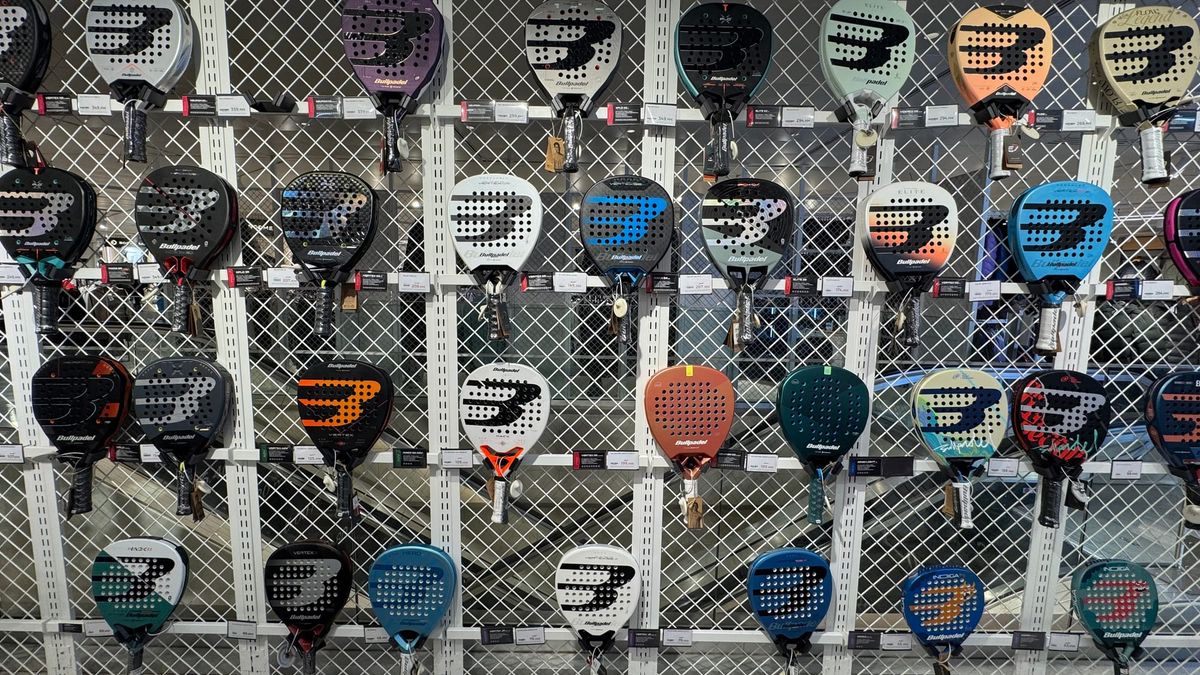
In February 2020, I took a photograph in Madeira. It was one of those pictures you take for the landscape and only really look at years later.
When I eventually did, I noticed something in the foreground: padel courts.
I remembered them immediately. They were close enough to the hotel for me to hear the repetitive pop of the ball. At the time, I barely registered the sport itself. I mentally filed it somewhere under Southern European leisure: sunshine, courts, people doing something vaguely tennis-like while I was doing something else.
Then I started seeing padel everywhere.
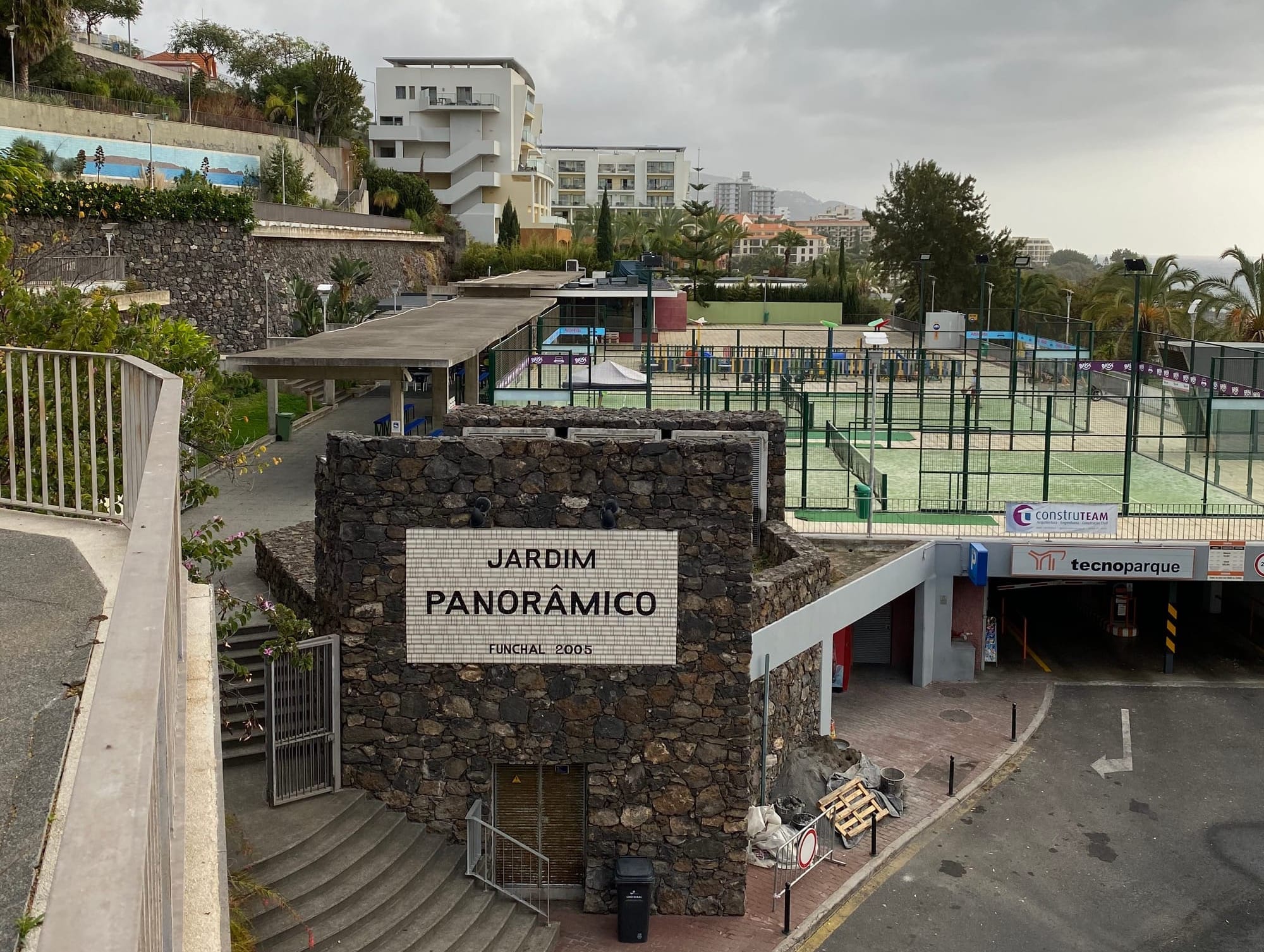
In Barcelona, this is not particularly difficult. There are clubs, courts, shops and enormous walls of rackets. Passing another large padel centre near Blanes finally made me wonder why this particular sport had become so extraordinarily visible.
That was supposed to be a small question.
It did not remain one for very long.
A frying pan with cultural capital
A padel racket looks, to me, a little like a frying pan with holes in it.
This is not meant disrespectfully. Some of these frying pans cost close to €300.
Walking through the sports department of El Corte Inglés in Barcelona makes the scale of the market immediately obvious. Padel does not occupy a sad corner beside miscellaneous recreational equipment. It has racks of clothing, bags, accessories and walls upon walls of rackets. Some cost relatively little. Others sit firmly in premium territory.
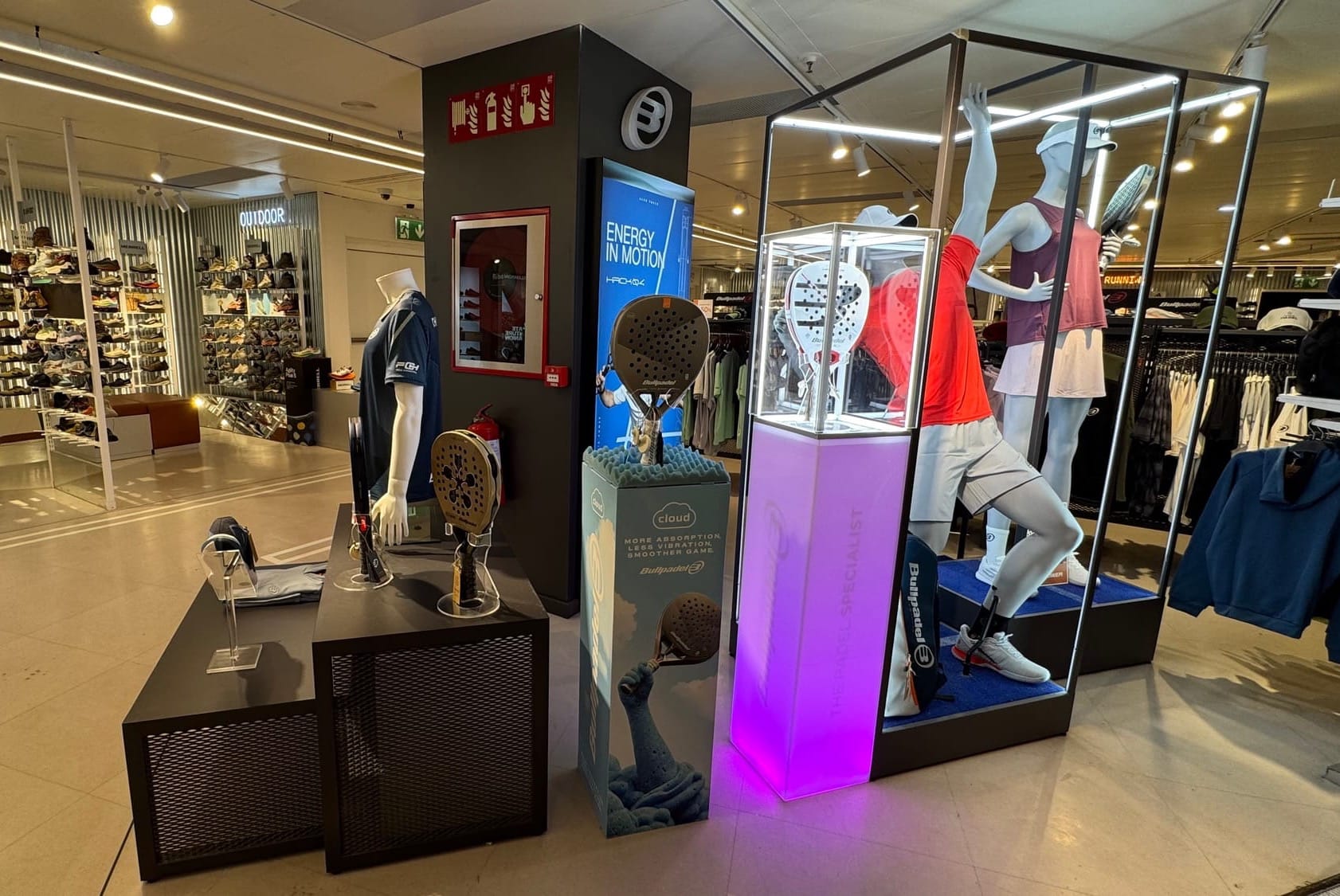
And here Pierre Bourdieu becomes difficult to avoid.
I know this mechanism from another racket sport. Years ago, I played squash intensely enough to have a coach, practise drills on my own and develop very particular equipment preferences. I owned a Harrow Renegade racket that weighed around 140 grams and felt almost absurdly light in my hand. I had Salming indoor shoes because the previous pair did not give me the traction I wanted. I had a proper thermobag, protective glasses and my preferred grips.
None of this made me an elite squash player.
But it did mean that I had started learning how to read the material culture of the sport.
This is where reducing expensive sports equipment to a simple status symbol becomes too easy. A good racket can signify knowledge, commitment and belonging — but it can also simply work better for a particular player. Weight matters. Balance matters. The size and position of the sweet spot matter. Shoes either grip the floor properly or they do not.
The object works and means at the same time.
An expensive racket can therefore become something more interesting than a display of wealth. It can become a claim to insiderhood.
The crucial word, however, is claim.
You can buy the signs of competence much faster than you can acquire competence itself.
A complete beginner can arrive with carbon fibre, specialist shoes, the right bag and a racket used by professionals. None of those objects can purchase the hundreds of embodied decisions through which someone actually learns a sport.
Economic capital can buy entry very quickly.
Habitus takes longer.
It takes four to tango
Padel has another feature that makes it sociologically interesting: the standard game needs four people.
It may take two to tango, but it takes four to play padel.
That creates an extremely mundane problem. Where do the other three come from?
If you already have them, you possess something more than the ingredients of a match. You have a network.
Friends, colleagues, couples and acquaintances can turn the sport into a recurring social ritual: the same group on Wednesday evening, perhaps followed by a drink or dinner. In that model, social capital comes before the game. You play because you already know people who play.
But what happens when you do not?
There is, inevitably, an app for that.
I thought I was downloading a booking app
I registered for Playtomic because I wanted to see the infrastructure around padel more clearly.
I expected courts.
I got people.
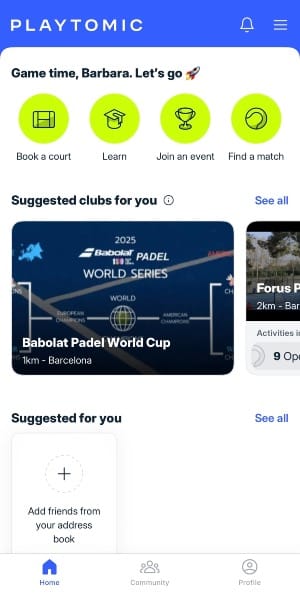
The app certainly allows you to find clubs, book courts, join lessons and browse matches. But alongside those functions sits a recognisably social-media-like architecture: profile photographs, names, followers and following, messaging, match histories, levels, reliability scores and public activities.
A minimal system for arranging a game would require surprisingly little information.
Thursday, 7 p.m.
Three places available.
Approximate level.
Join.
Playtomic gives you considerably more.
A player becomes a profile.
Making strangers legible
There are two different kinds of information operating here.
The first is functional. How well does someone play? Are they available? Is their level reasonably compatible with mine? Can we have a match that will not be miserable for everyone involved?
That information makes another player playable.
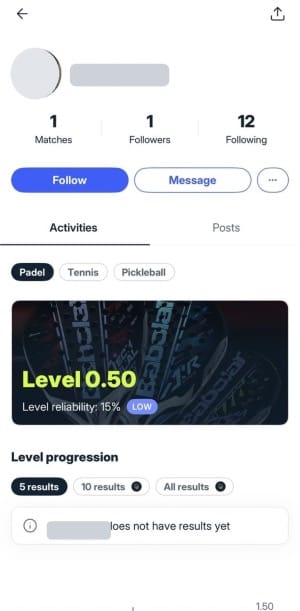
The second kind is social. A face. A name. Followers. Following. Activity. A profile that can be followed or messaged.
That information makes another player socially visible.
To arrange a balanced match, I need to know roughly how well you play.
I do not need to know what you look like.
Yet the platform gives me both.
That does not make the photograph useless. Recognising someone when four strangers arrive at the same club has obvious practical value. But it also places sporting interaction inside a broader platform culture in which strangers become visually and socially legible before they physically meet.
The group begins to exist before anyone reaches the court.
And this matters because an affordance for one person may be friction for another.
For someone who has moved to a new city, wants to play and knows nobody, the ability to enter an open match can be fantastic. The platform reduces the social cost of lacking an existing network.
For someone who would happily play with friends, colleagues or friends-of-friends but has little desire to spend an evening with three entirely random profiles, the same feature solves a logistical problem while creating a social one.
The technology is identical.
The experience is not.
Turning a player into data
Padel also produces a fascinating little hierarchy of competence.
Clubs and events may use categories such as beginner, intermediate or more local letter-and-number systems. Playtomic adds something else: a numerical rating accompanied by information about its reliability and the player's recorded activity.
Embodied competence becomes a metric.
This is useful. Four people who are wildly mismatched in ability may not have much fun.
But the number also performs a familiar platform trick: something fluid, contextual and bodily becomes portable data.
And, of course, identical numbers do not mean identical bodies.
Imagine two people who have never played padel.
One has never held a racket.
The other has spent years playing tennis or squash.
The platform may initially see two beginners.
Bourdieu would see two different histories embodied in two different bodies.
The second person still has to learn padel. The walls are different. The racket is different. The positional logic is different. But hand-eye coordination, footwork, timing and the sensory knowledge of what a clean contact feels like do not disappear merely because the sport has changed.
A rating can describe performance.
It cannot contain the entire history that produced it.
And if you do not know how to play?
The platform also makes the pathway into the sport unusually visible.
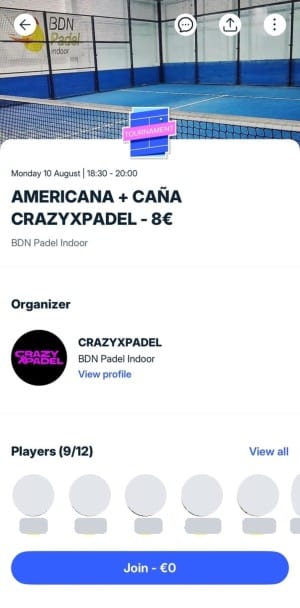
There are lessons and academies, beginner events, open matches and various social or competitive formats. Americano events can rotate partners and opponents. Mexicano formats can adjust later pairings according to results. Leagues add another layer of regularity and competition.
In other words, the infrastructure does not merely help people who already play.
It helps construct players.
Learn.
Acquire a level.
Join a match.
Play an event.
Enter a league.
The platform does not simply mediate an existing sporting practice. It can help build a pathway into the field.
And that pathway has a commercial ecosystem attached to it: coaching, court fees, equipment, events, subscriptions, branded tournaments and an almost comically large quantity of specialised stuff.
Which brings us back to Bourdieu.
The important distinction may no longer be simply between people who play padel and people who do not.
As a sport becomes easier to access, distinction can migrate inward.
Where do you play? How often? With whom? What level? Which club? What racket? Do you know why that racket suits you?
Mass participation does not necessarily eliminate distinction.
It can produce more places for distinction to hide.
Mapping padel without leaving the sofa
Playtomic also became unexpectedly useful to me as a research tool.
I started moving around the map.
Barcelona. Madrid. Lisbon. Málaga. Zaragoza. Paris. Katowice. Amsterdam. Berlin.
This was not quantitative research and I would never treat the resulting map as a census of sporting infrastructure. Playtomic does not map every court that exists. It maps the infrastructure that exists on Playtomic.
That distinction became particularly obvious when I searched for squash. The app made squash look surprisingly sparse in places where a simple map search showed that squash facilities certainly existed.
The platform does not show reality.
It shows the part of reality that has become legible to the platform.
But that is itself interesting.
Clubs, prices, events, lessons, ratings and social structures become visible through one interface. A platform designed partly to organise leisure also becomes a window through which that leisure can be observed.
So much for my Southern European theory
The map also destroyed one of my own assumptions.
For years, I had mentally associated padel with Southern Europe. My first clear memory was Madeira. Then came Spain, Portugal and France. Barcelona only strengthened the association.
And then I opened Amsterdam.
There it was again.
Berlin too.
And Katowice.
I do not mean that padel occupies exactly the same place in all of these cities, or that its local cultures are interchangeable. Quite the opposite: that would require completely different research.
What interested me was much simpler.
My geographical intuition had been wrong.
Padel was not a peculiar little feature of the sunny European South that I had happened to notice while travelling. It was part of a much wider expansion.
Sometimes research begins not when your theory is confirmed, but when reality tells you to stop being so pleased with it.
The court is local. The profile travels
The physical game remains stubbornly local.
You need a court. You need four bodies. You need them in roughly the same place at roughly the same time.
The player, however, has become portable.
A profile can carry a rating, history and social connections from one match to another and potentially from one city to another. Before arriving somewhere, you can already browse clubs, matches and events.
The court remains concrete.
The social infrastructure surrounding it increasingly does not.
That is what makes padel more interesting to me than the simple question of whether it is fashionable.
It sits at the intersection of embodied sport, material consumption, urban leisure, social capital and platformisation.
And all of that can emerge from something as apparently trivial as four people hitting a yellow ball around a glass box.
I may still end up buying the frying pan
I still have not played padel.
At this point, however, I know considerably more about padel rackets than a person who has never played padel has any reasonable need to know.
I already know that I would probably look for something light, manoeuvrable and relatively neutral in balance. Years of squash have apparently left me incapable of simply looking at a racket and thinking, nice colour.
But whether I ever buy one will probably depend less on the racket than on the people.
If someone I know says, “We need a fourth, do you want to come?”, I probably will.
If the invitation is simply a grid of strangers in an app, perhaps not.
And maybe that is the point.
Padel may be extraordinarily platformable, but leisure does not become social merely because software makes people available to one another.
Sometimes the network still comes first.
And sometimes the most convincing evidence that a sport has become mainstream appears somewhere much less glamorous than a club, an app or a premium sports department.
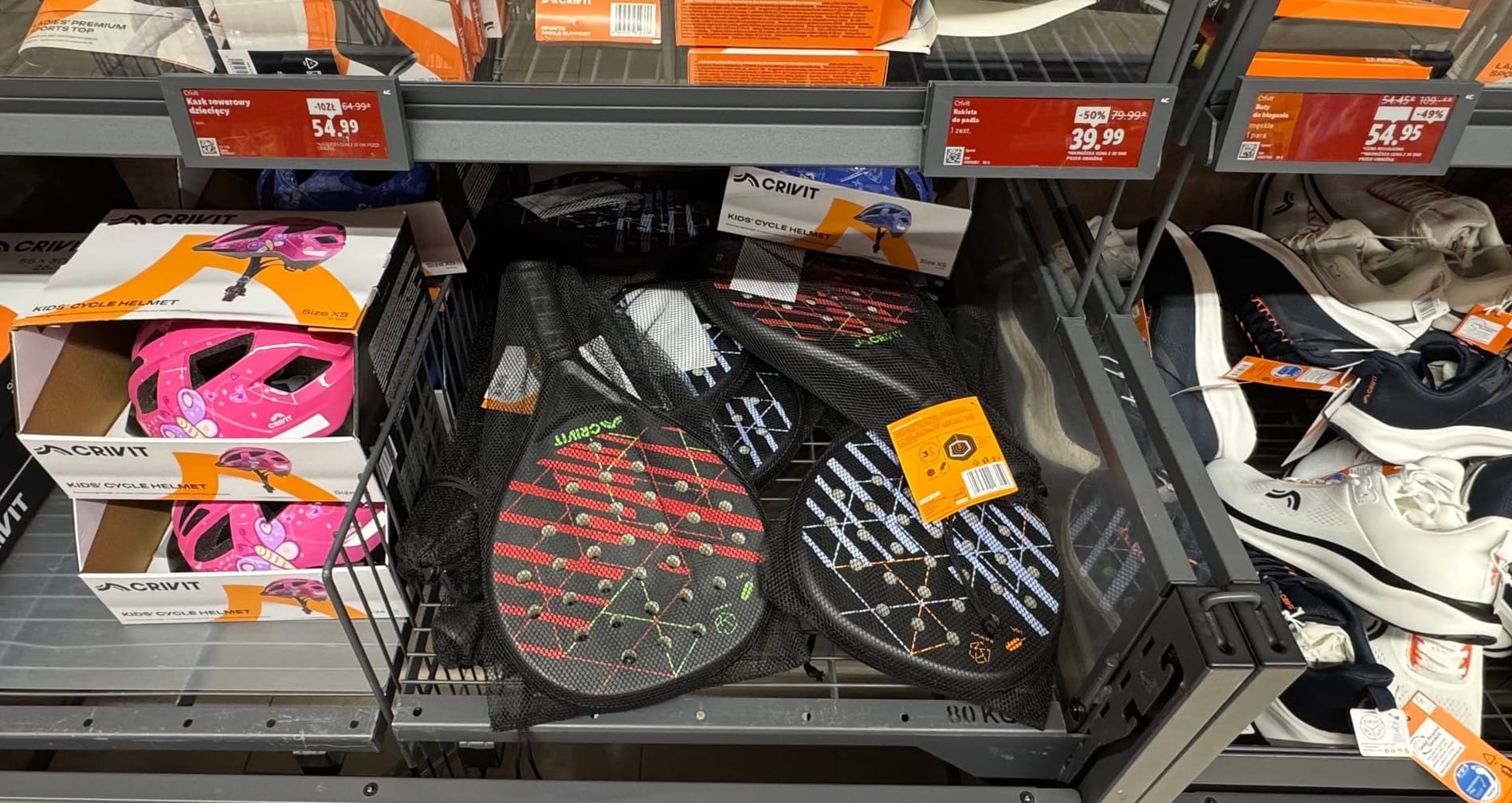
I recently went to Lidl for eggs, bananas and peaches.
There was a full-size padel racket on sale for around €9.
At that point, a sport has travelled quite far indeed.