The strange afterlife of Spain's most famous roadside bull

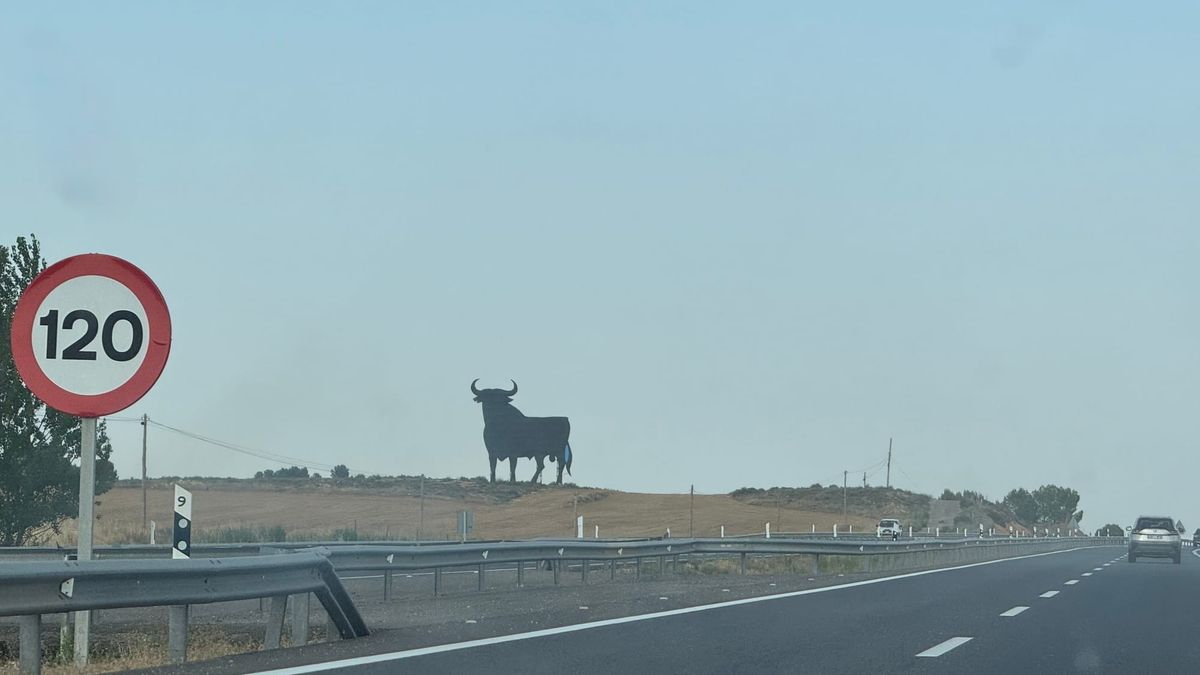
At first, I photographed every Osborne bull I saw.
Some appeared suddenly on a hill in the distance, black against a vast blue sky. Some emerged from behind dry fields and low mountains. Some were so monumental that they seemed less like objects and more like presences — as if they had always belonged there, as if they had grown out of the landscape rather than been placed into it.
That, perhaps, is the first thing one notices about the Osborne bull in Spain: it does not really look like an advertisement anymore.
This is part of what makes it so compelling. On many Spanish roads, especially once you leave the cities behind, the landscape is not cluttered with the kind of visual noise one often associates with driving elsewhere. There are no endless sequences of giant billboards shouting about lingerie, car dealerships, cheap toll passes, mineral water, supermarkets, or holiday resorts. There are fields, hills, open land, dry summer light — and then, every now and then, the silhouette of a bull.
It does not interrupt the landscape.
It emerges from it.
And yet that black silhouette did begin as an advertisement. More specifically, it began as a giant roadside advertisement for Veterano, a brandy produced by the Osborne company. Designed in 1956 by the graphic artist Manuel Prieto for the Azor advertising agency, the first bull was installed in 1957 in Cabanillas de la Sierra, near Madrid. At first it was only four metres high and made of wood. Over time it changed: by 1961, the structure was being made of metal sheeting, and later legal changes pushed the company to make it larger and place it farther away from the road. Eventually, it reached the now iconic height of 14 metres.
The legal history matters here, because without it the bull might never have become what it is today.
In 1988, Spanish road legislation prohibited advertising visible from public roads. In theory, that should have meant the end of the Osborne bulls. In fact, the brand name was removed from them, leaving only the silhouette. Later, in the 1990s, there were further attempts to eliminate the structures entirely. And yet, in 1997, the Spanish Supreme Court allowed them to remain, arguing that they had acquired aesthetic and cultural value that went beyond their original commercial purpose.
That ruling marked a turning point. Officially and symbolically, the bull ceased to be just a billboard.
It had become something else.
That “something else” is what makes the Osborne bull so interesting. It is not simply a matter of history or nostalgia. It is a matter of meaning — and of how meaning changes.
The shape of the bull has not changed very much. What changed was the meaning attached to it.
At first, the bull meant a product. It meant Veterano. It meant Osborne. It told drivers what to buy, or at least what to remember.
Then, once the lettering disappeared, it no longer told people anything so direct. It stopped saying drink this. It became visually open. The message had been stripped away, but the sign remained. And because the sign remained, people were suddenly free to attach other meanings to it.
This is the most fascinating part of its story.
The Osborne bull became a sign that outgrew its brand.
It became associated with road trips, with family holidays, with looking out of the car window, with summer heat, with the feeling of going somewhere. Several generations in Spain grew up seeing these black silhouettes appear on the horizon during long drives. For many people, the bull entered what might be called the country’s emotional landscape: not just the physical landscape of hills and roads, but the landscape of memory.
In that sense, it is entirely understandable that people defended it. They were not necessarily defending a brandy company. They were defending a familiar visual presence, something that had become part of how Spain looked and felt.
But memory alone does not explain everything.
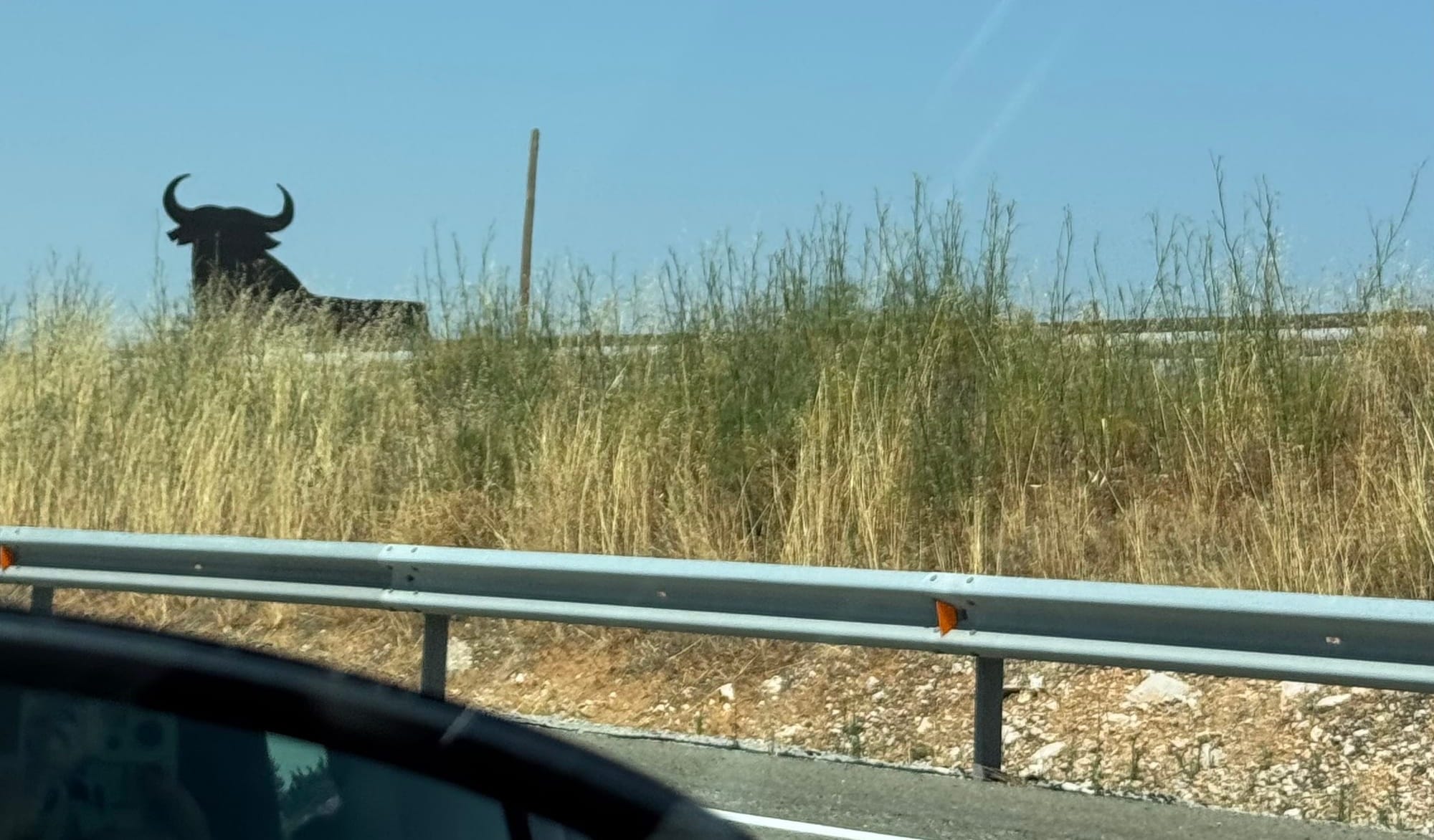
The bull did not stop at becoming nostalgic. It went further. It migrated into souvenirs, T-shirts, posters, sports culture, stickers, illustration, popular design. It became one of the most immediately recognizable graphic forms in Spain. Even people who no longer connect it directly with Osborne often recognize the silhouette at once.
This is where the semiotic shift becomes particularly interesting.
The bull moved from product to brand, from brand to landscape, and from landscape to Spain.
Not just a company. Not just a road. Not just a memory.
Spain.
And the moment a sign comes to stand for “Spain,” another question follows almost immediately: whose Spain?
This is the question that many simpler articles about the Osborne bull leave untouched. They are often happy to tell the charming story of how a roadside advertisement somehow became an icon of the country. What they do not usually ask is what it means for a commercial sign to become a symbol of Spanishness in a country where Spanishness itself is not experienced, defined, or embraced in the same way everywhere.
Because the Osborne bull is not distributed evenly across Spain. Today there are 92 bulls spread across 14 autonomous communities. They are especially numerous in Andalusia and in parts of central Spain. But in Catalonia, there are none. And that absence is meaningful.
There used to be one in El Bruc, in Catalonia. It was repeatedly attacked, rebuilt, attacked again, and eventually removed for good. For some, the bull was simply an element of the landscape. For others, it was a symbol of Spanish nationalism, of a centralized idea of Spain imposed onto a region with its own language, identity, and political tensions.
That is why the story of the Osborne bull cannot be told properly without mentioning the Catalan donkey.
The donkey is not just a cute local mascot. It is a counter-symbol. It answers the bull in symbolic terms. If the bull has come to represent Spain, then the donkey can represent Catalonia. If one black animal silhouette claims a road, a bumper sticker, or a national imagination, another can push back.
This is where semiotics becomes visible even to those who have never heard the word.
A symbol becomes powerful, and another symbol appears to resist it.
The bull, then, is not merely a beautiful example of a logo that escaped its original purpose. It is also an example of what happens when a sign becomes culturally dominant: it invites imitation, opposition, parody, reappropriation, and conflict.
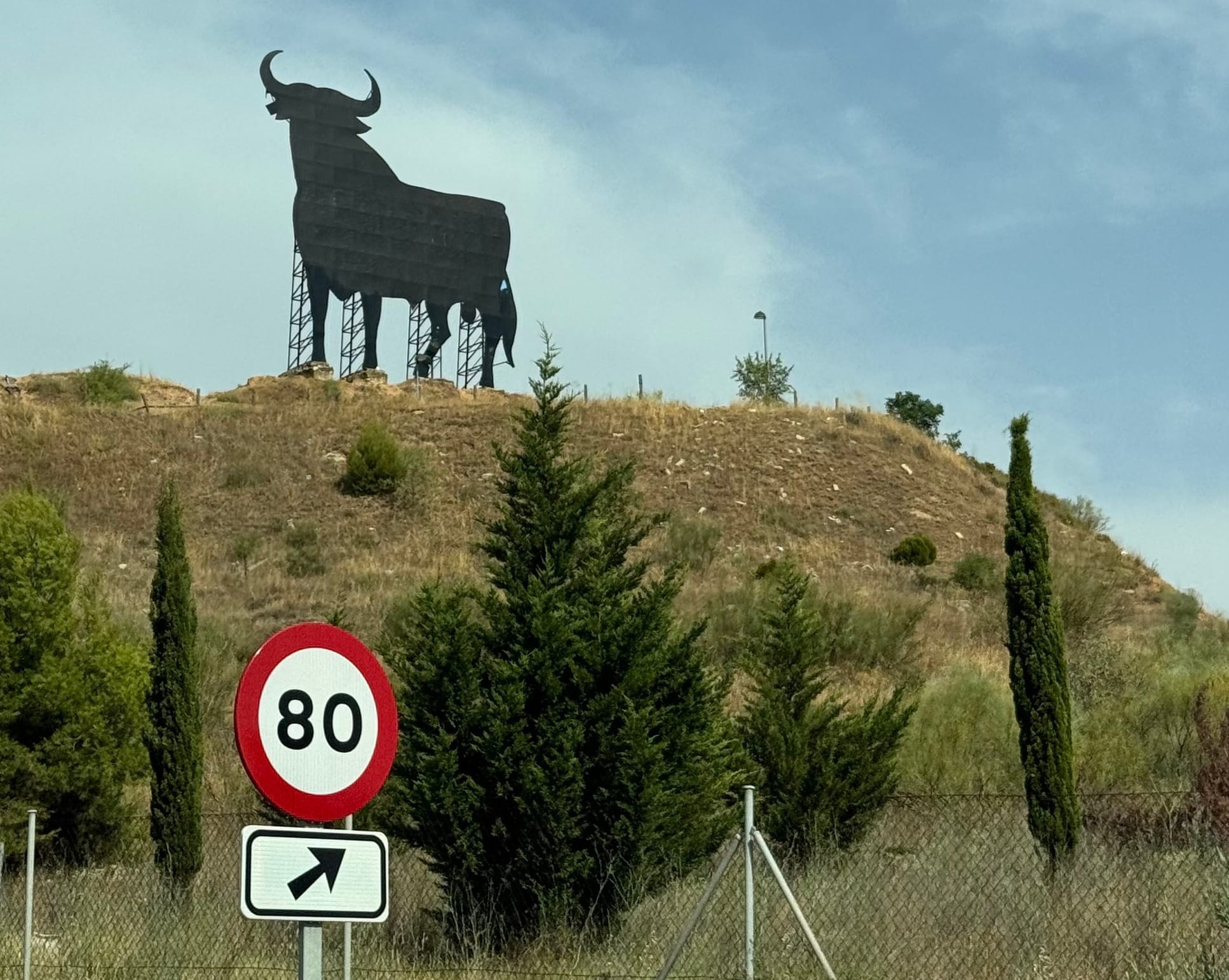
Over the years, Osborne bulls have been painted over, transformed, vandalized, and artistically reinterpreted. Some have been covered with rainbows or flowers. Others have been turned into cows, or used as surfaces for political protest. From the perspective of the company, these are acts of damage against private property. From the perspective of cultural politics, they are attempts to make the symbol say something else.
That, too, is part of the life of a sign.
A sign truly matters when people fight over what it means.
And so the Osborne bull lives several lives at once.
For Osborne itself, it remains part of the company’s legacy and identity. The brand continues to present it as a proud cultural symbol, something rooted in tradition but still open to contemporary reinterpretation through art, fashion, and collaborations.
For many drivers and travellers, it remains part of the road — a familiar, almost comforting shape that appears and disappears on journeys through Spain.
For popular culture, it is a graphic icon: clean, striking, minimal, unmistakable.
For some critics and activists, however, it is also a loaded image — a symbol of a particular version of Spain, one tied to centralism, to bullfighting, to masculinized folklore, or to a state identity that does not feel neutral everywhere.
All of these readings coexist.
That is what makes the bull so rich as an object of cultural analysis. It is not one thing. It is not even one symbol. It is a structure onto which different generations, institutions, regions, and individuals have projected different meanings.
And yet, when you first encounter it on the road, none of that complexity arrives immediately.
What arrives first is visual.
A hill. A field. A wide horizon. And then the bull.
That may be why it works so well. Its meaning is complex, but its form is simple. A child can recognize it. A tourist can photograph it. A designer can admire it. A politician can distrust it. A brand can claim it. A region can resist it.
It is a rare case of a sign that became more powerful by losing its original message.
Once the words disappeared, the bull began to speak more loudly than before.
Perhaps that is why it fascinates me so much. Not just because it is photogenic — though it is. Not just because it punctuates road trips with a kind of monumental drama — though it does. But because it embodies something larger about Spain itself: the strange way in which landscape, memory, commerce, identity, and politics are constantly folding into one another.
A roadside advertisement became a cultural symbol.
A cultural symbol became part of the emotional landscape.
And part of that emotional landscape became a political argument.
The next time you see an Osborne bull from the road, it may still look solitary, almost serene, as if it has simply always been there. But it carries much more than its silhouette suggests. It carries a brand. A memory. A country. And a question.
Not just what is this?
But what does it mean — and to whom?