Where Did Everyone Go? Driving Through Empty Spain

I had seen parts of this landscape before.
First, on the way to Zaragoza the previous year. Then again while travelling to Valencia. Later, on two separate journeys to Madrid.
At first, I barely questioned it.
Spain beyond the Mediterranean coast simply looked different from the country I had imagined before moving here. The colours were warmer, the hills drier, the sky somehow larger. There was something almost cinematic about it. At times, it reminded me of the landscapes from old Western films—vast open spaces, dusty hills and roads disappearing towards the horizon.
Only gradually did I realise that it wasn’t just the scenery that felt different.
It was the absence of people.
The first time I truly noticed it was from the train between Barcelona and Madrid.
Somewhere beyond Zaragoza, I found myself staring out of the window for long stretches without really knowing why. The train raced through fields, crossed rivers and passed the occasional village, yet something felt strangely unfamiliar.
I kept waiting for another town.
Another cluster of houses.
Another sign that everyday life was happening somewhere nearby.
Sometimes it appeared.
More often, it didn’t.
That was when one simple question came to mind.
Where did everyone go?
Growing up in Upper Silesia probably made the contrast even stronger.
Back home, you can drive from one town almost seamlessly into another. The urban landscape rarely pauses for long. Even elsewhere in Poland, a train journey usually means passing villages, scattered houses, farm buildings, small roads and countless reminders that people live here.
The scenery changes, but human presence rarely disappears.
Here, it felt different.
The distances between settlements seemed enormous. The land was clearly cultivated. There were railway tracks, local roads, electricity lines and modern infrastructure.
Yet for kilometres at a time, there appeared to be almost nobody.
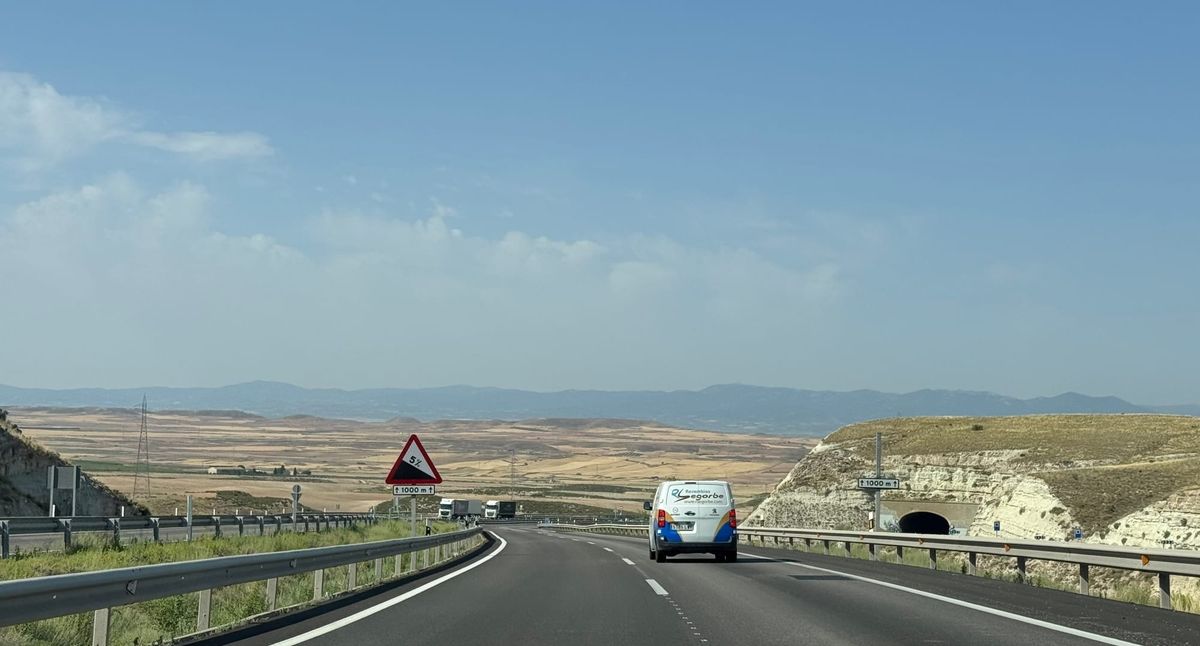
Months later, driving through the same region with Javi, I realised it hadn’t been an illusion created by looking through a train window.
The landscape looked exactly as I remembered.
Wide motorways stretched across Aragón with surprisingly little traffic. Dry hills rose on both sides of the road, interrupted only occasionally by small villages that seemed almost frozen in time.
Looking back, I realised something curious.
It wasn’t that the landscape was empty.
It was that the infrastructure wasn’t.
The roads were excellent.
The railway was fast.
Bridges, junctions and service areas appeared exactly where you would expect them.
What felt missing was the number of people these places seemed designed to serve.
By then, several journeys had begun to merge into one story.
What I had initially dismissed as “just another landscape” slowly revealed itself as one of the most fascinating social phenomena in modern Spain.
It even had a name.
La España Vaciada.
The phrase is usually translated into English as Empty Spain.
But that translation misses an important nuance.
Spanish distinguishes between España vacía—a country that is empty—and España vaciada—a country that has been emptied.
That single letter changes everything.
The first describes a landscape.
The second asks a question.
Who left?
And why?
Over the second half of the twentieth century, millions of Spaniards left rural areas in search of work in Madrid, Barcelona, Bilbao, Valencia and along the Mediterranean coast. Others emigrated to France, Germany and Switzerland.
Young people left first.
Families followed.
Schools closed because there were no children.
Bus routes disappeared because there were too few passengers.
Small shops shut their doors.
Medical services moved elsewhere.
Each departure made the next one more likely.
What remains today is one of Europe’s most remarkable demographic contrasts.
While Spain’s major cities continue to grow, vast parts of the country’s interior have some of the lowest population densities in Western Europe.
Suddenly, the silence outside my train window made sense.
Since learning about La España Vaciada, I have noticed how often international media present it as a curiosity.
Entire villages for sale.
Free houses.
Municipalities looking for new residents.
The headlines almost write themselves.
The reality is rather more complicated.
Buying an abandoned house may be possible.
Bringing an abandoned village back to life is something else entirely.
A community needs schools, doctors, public transport, local businesses and jobs.
A beautifully restored stone house means little if there is nobody left to keep everyday life going around it.
That, perhaps, is the biggest misconception about Empty Spain.
It is not simply a story about abandoned buildings.
It is a story about communities.
Looking back at those journeys now, I realise I wasn’t searching for spectacular landscapes.
I was trying to understand why such a large part of one of Europe’s most visited countries felt so unexpectedly quiet.
And perhaps that is what stayed with me most.
Not the dry hills.
Not the empty roads.
Not even the villages.
But the silence.
Because sometimes the most interesting thing about a place isn’t what you can see.
It’s what used to be there.